
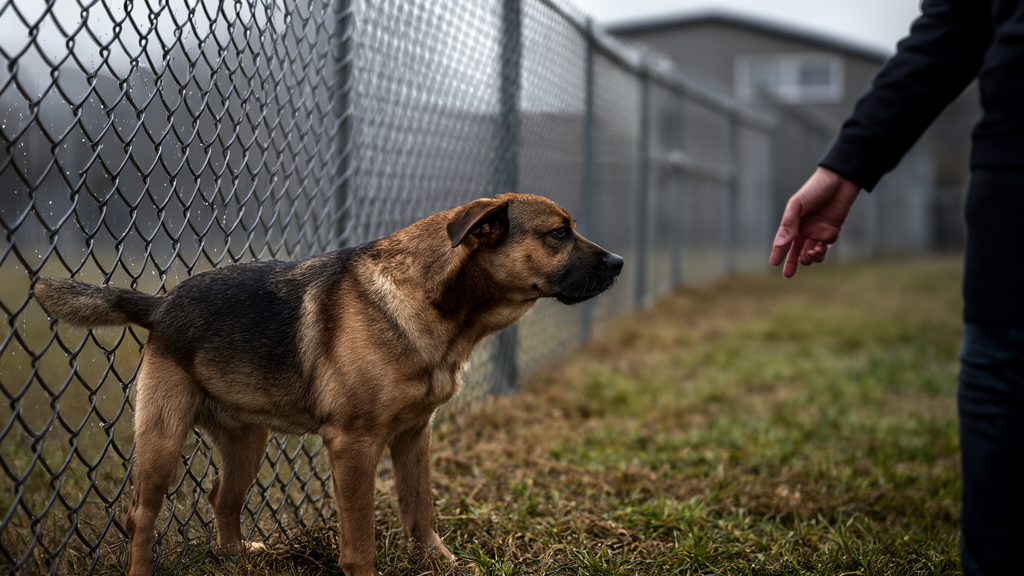
You call your dog’s name. He looks up. He hears you. And then he keeps walking, tail low, ears back, toward the fence line. You call again, louder. He moves faster. This is the moment every rescue owner knows, and it’s the exact moment that breaks the trust you’re trying to build.
When a dog has spent months or years in a shelter, kennel, or transient foster situation, the command “come” is not a request. It is a high-risk gamble. Every time you call and he doesn’t come, or worse, he comes and gets handled roughly, corrected, or punished, you are teaching him that your voice predicts discomfort. The solution is not a louder voice. It is a complete tactical reset of how you use that word.
Why the Command Fails in the First Place
Shelter dogs do not arrive with a blank slate. They arrive with a history of negative associations. In a kennel environment, the person calling the dog is often the person closing the gate, spraying the floor, or moving the dog to a new, unfamiliar space. The sound of your voice became a predictor of the end of freedom, the end of comfort, or the end of a familiar routine. This is classical conditioning at work, and it is not something the dog can simply “decide” to unlearn.
Furthermore, rescue dogs are often highly vigilant. They are scanning for threats, reading body language, and processing a thousand environmental cues. When you call them, you are asking them to break that vigilance and move toward you. For a dog who has been ignored, rejected, or punished, moving toward you is the most vulnerable thing they can do. They are choosing to trust you over their own survival instinct. That is a massive ask, and it is why the standard “come” command fails so spectacularly.
The Tactical Reset: How to Earn the Come
You must stop using the word “come” as a command until the dog offers it voluntarily. This means no more calling him to the car, no more calling him away from something he likes, no more calling him for a bath or a nail trim. You are going to retire the word entirely for at least three weeks. This feels counterintuitive, but it is the only way to break the negative association.
Instead, you will use a marker word or a clicker to build a positive association with the sound of your voice. When he looks at you, you mark it. When he takes a step toward you, you mark it. When he arrives, you reward him with something incredibly high-value: boiled chicken, hot dogs, cheese, whatever he has never seen before. You do not ask for anything. You do not ask him to sit. You do not ask him to stay. You simply call him, he comes, and life gets amazing. Then you let him go back to sniffing the fence.
This is not a trick. This is counter-conditioning. You are rewriting the neural pathway that says “owner’s voice = bad thing” to “owner’s voice = amazing thing.” It takes time. It takes patience. It takes the willingness to let him ignore you sometimes, because forcing the interaction will only reset your progress.
When the Reset Fails: The Honest Limits
This protocol works for the vast majority of rescue dogs who have developed a hesitation around the recall command. It does not work for dogs with severe trauma responses that manifest as flight or freeze. If your dog is so terrified that he bolts the moment he hears your voice, or if he shuts down completely and refuses to move, this protocol needs to be adapted by a professional behavior consultant who can work with him in small, manageable increments.
Additionally, this reset requires absolute consistency from every member of the household. If you are retiring the word “come” but your partner still calls the dog to the car, the association will not break. If you are rewarding him with chicken but then grab his collar and force him into the house when he arrives, you are sending mixed signals that will confuse him and stall his progress. This is not a solo mission. It is a household commitment.
The Payoff: Why This Matters Beyond the Command
When you successfully retrain a rescue dog to come when called, you are not just teaching him a trick. You are giving him a tool to navigate a world that has repeatedly shown him that he is not safe. Every time he chooses to come to you, he is proving to himself that he can trust you. Every time you reward him, you are proving to him that he is worthy of reward. This is the foundation of the bond you are trying to build, and it is why this specific behavior is the single most important thing you can work on in the first ninety days of ownership.
Stop calling him. Start earning him. The rest will follow.
Frequently Asked Questions
How long does the recall reset take?
Most dogs show significant improvement within three to four weeks of consistent practice. Some deeply traumatized dogs may take two to three months. Do not rush the process, as rushing will reinforce the negative association you are trying to erase.
What if my dog still ignores me after three weeks?
If there is no progress after three weeks of strict adherence to the protocol, consult a certified professional behavior consultant. There may be underlying medical issues, such as hearing loss, or a trauma response that requires a more specialized approach.
Can I use the recall for safety emergencies?
Yes. If your dog is in immediate danger, such as running toward a busy road, you must use the recall. However, you should pair this with a long-line leash during training so you can physically guide him to safety without breaking the positive association. Always reward him heavily after an emergency recall to reinforce that coming to you is the right choice, even in high-stress situations.