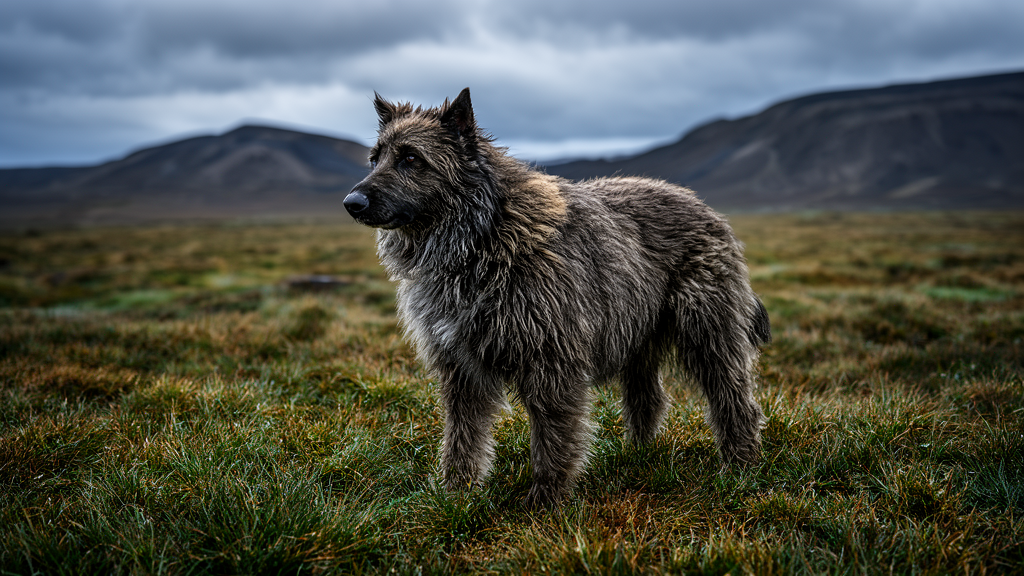
More than half the genetic variants that give the Icelandic Sheepdog its coat are not decorative. They are direct descendants of the survival requirements of a dog that had to work in a subarctic climate where the temperature drops below zero for half the year, and where the dog’s job was to herd reindeer and sheep across volcanic terrain with no cover.
The thick, plush coat everyone admires is not a fluke. It is the visible result of 1,100 years of selective breeding for a specific working purpose. The breed did not evolve its coat by accident. It evolved it because dogs that lacked the right genetic variants for insulation, weather resistance, and thermoregulation simply did not survive the Icelandic winters. The coat is the physical manifestation of that selection pressure.
Understanding the Icelandic Sheepdog’s coat means understanding the breed’s history, its working purpose, and the specific genetic mechanisms that make it work. It also means understanding what modern owners need to do to maintain it, and why the breed’s grooming requirements are fundamentally different from other double-coated breeds.
The Viking Arrival and the Genetic Bottleneck
The Icelandic Sheepdog’s story begins with the Vikings who settled Iceland around 874 CE. These settlers brought their dogs with them, dogs that were likely similar to the Norwegian Buhund and the Swedish Vallhund, breeds that share a common Nordic herding ancestry. These dogs were essential to the survival of the early settlements. They herded sheep and reindeer, guarded homesteads, and helped with hunting. They were not companion animals. They were working tools.
The critical event in the breed’s history was the isolation of Iceland. As the settlements established themselves, the Icelandic government eventually banned the importation of foreign dogs. This was not a ban on trade or culture; it was a practical decision. Foreign dogs introduced diseases, particularly canine distemper and parvovirus, which decimated the local dog population. The ban was enforced for centuries, creating a closed genetic pool. There were no new bloodlines introduced. The breed had to survive entirely on the dogs already present in Iceland.
This isolation created a genetic bottleneck. The population was small, and the dogs that survived were those best adapted to the harsh environment. The coat was one of the most important factors in that survival. Dogs with thinner coats, less dense undercoats, or coats that did not shed properly were less likely to survive the winter. Over 1,100 years, this selection pressure shaped the breed’s coat into what it is today.
The genetic bottleneck also meant that the breed retained certain primitive traits. The Icelandic Sheepdog is one of the few breeds that still exhibits the “prince” or “princess” markings, small patches of white on the chest or paws that are considered a fault in many other breeds but are perfectly normal in the Icelandic Sheepdog. These markings are a remnant of the breed’s ancient ancestry, and they are a reminder that this breed has remained largely unchanged for over a millennium.
The Anatomy of a Double Coat
The Icelandic Sheepdog has a double coat, which consists of two distinct layers: the outer coat (guard hairs) and the undercoat. Both layers are essential to the breed’s function, and both require specific care to maintain.
The outer coat is composed of longer, coarser guard hairs that provide weather resistance. These hairs are water-repellent and help shed rain, snow, and dirt. They are also slightly longer than the guard hairs of many other double-coated breeds, giving the Icelandic Sheepdog its characteristic shaggy appearance. The outer coat is what you see when you look at the dog, and it is what gives the breed its distinctive silhouette.
The undercoat is a dense, soft layer of insulating hairs that lies close to the skin. This layer is responsible for the breed’s incredible insulation properties. The undercoat traps a layer of air close to the dog’s body, which is then warmed by the dog’s body heat. This trapped air acts as an insulator, keeping the dog warm in cold weather and cool in warm weather. The undercoat is what makes the Icelandic Sheepdog so well-suited to the Icelandic climate.
The combination of these two layers creates a coat that is both weather-resistant and highly insulating. This is not a coat that is designed for aesthetics. It is a coat that is designed for survival. The breed’s coat is a direct result of the environmental pressures it faced over 1,100 years, and it is a testament to the power of natural selection.
Genetic Markers That Define the Breed
Modern genetic research has identified several specific genetic variants that contribute to the Icelandic Sheepdog’s coat. These variants are not unique to the breed, but they occur in specific combinations that create the breed’s distinctive coat.
One of the most important genetic variants is the FGF5 gene, which controls hair length. In most dogs, a mutation in this gene results in long hair. In the Icelandic Sheepdog, the gene is in its wild-type form, which results in medium-length hair. This is important because long hair can mat easily, especially in a breed that works in harsh environments. The medium-length coat is a practical compromise between insulation and manageability.
Another important genetic variant is the RSPO2 gene, which controls the presence of furnishings (eyebrows, beard, and mustache). The Icelandic Sheepdog carries the wild-type version of this gene, which results in the absence of heavy furnishings. This is another practical adaptation, as heavy furnishings can trap moisture and debris, which is undesirable in a working dog.
The third important genetic variant is the KRT71 gene, which controls hair curl. The Icelandic Sheepdog carries a mutation in this gene that results in a slightly wavy coat. This wave is not as pronounced as in some other breeds, but it adds to the coat’s density and insulation properties. The wave also helps the coat shed water more effectively, which is important in a wet climate.
These genetic variants are not unique to the Icelandic Sheepdog, but they occur in specific combinations that create the breed’s distinctive coat. The breed’s coat is a direct result of these genetic variants, and it is a testament to the power of selective breeding.
What This Means for Modern Owners
Understanding the Icelandic Sheepdog’s coat means understanding what the breed needs from its owners. The breed’s coat is not low-maintenance. It requires regular grooming to prevent matting, to remove dead undercoat, and to maintain the coat’s weather-resistant properties.
The most important aspect of Icelandic Sheepdog grooming is the seasonal shedding. Twice a year, the breed sheds its undercoat in what is known as a “blow coat.” During this time, the dog will shed large amounts of undercoat, and it is essential to remove this undercoat to prevent matting and to allow the new undercoat to grow in properly. This is not a time to skip grooming. It is a time to increase grooming frequency.
The best tool for removing the undercoat is a slicker brush or an undercoat rake. These tools are designed to reach the dense undercoat and remove it without damaging the outer coat. It is important to brush the dog thoroughly during the blow coat, working in sections to ensure that all of the undercoat is removed. This process can take several weeks, and it requires patience and consistency.
Outside of the blow coat, the breed requires regular brushing to prevent matting. A weekly brushing with a slicker brush is sufficient for most dogs. It is also important to check the dog’s ears, paws, and skin for any signs of irritation or infection. The breed’s coat can trap moisture and debris, which can lead to skin problems if not properly maintained.
One common mistake that owners make is shaving the breed’s coat. This is strongly discouraged. Shaving the coat removes the weather-resistant outer layer and the insulating undercoat, leaving the dog vulnerable to temperature extremes, sunburn, and skin damage. The coat is designed to regulate the dog’s body temperature, and removing it disrupts this natural mechanism. If the coat becomes matted, it should be professionally groomed, not shaved.
The Working Heritage Behind the Fluff
The Icelandic Sheepdog’s coat is not just a genetic curiosity. It is a direct result of the breed’s working heritage. The breed was developed to herd sheep and reindeer in a harsh, subarctic environment. The coat is one of the most important tools the dog has for performing this job.
The breed’s coat allows it to work in all weather conditions. The water-repellent outer coat sheds rain and snow, while the insulating undercoat keeps the dog warm in cold weather. The coat also provides protection from wind, volcanic ash, and rough terrain. The breed’s coat is a testament to the power of selective breeding, and it is a reminder that every aspect of the breed’s physical appearance has a functional purpose.
The breed’s working heritage also means that the dog has a high energy level and a strong work ethic. The breed was bred to work long hours in harsh conditions, and it still retains that drive today. Owners of the breed need to provide plenty of exercise and mental stimulation to keep the dog happy and healthy. A bored Icelandic Sheepdog is a destructive Icelandic Sheepdog.
The breed’s coat is also a reflection of its temperament. The breed is known for being friendly, outgoing, and eager to please. These are traits that were selected for in a working dog. A dog that is friendly and outgoing is easier to work with, and a dog that is eager to please is more likely to learn commands and perform tasks. The breed’s coat is a physical manifestation of its temperament, and it is a reminder that the breed’s physical and behavioral traits are deeply interconnected.
Why This Breed Deserves More Recognition
The Icelandic Sheepdog is one of the most misunderstood breeds in the dog world. Many people see the breed’s fluffy coat and assume that it is a high-maintenance companion dog. They do not see the working heritage, the genetic adaptations, and the practical demands of the breed’s coat.
The breed is not for everyone. It requires a committed owner who understands the breed’s needs and is willing to provide the exercise, grooming, and mental stimulation that the breed requires. It is not a breed for casual owners or for people who are looking for a low-maintenance pet.
But for the right owner, the Icelandic Sheepdog is an incredible companion. The breed is loyal, intelligent, and eager to work. The breed’s coat is a physical manifestation of its heritage, and it is a reminder that every aspect of the breed’s physical appearance has a functional purpose. The breed is a testament to the power of selective breeding, and it is a reminder that dogs are not just pets. They are partners.
The Icelandic Sheepdog is a breed that deserves more recognition. It is a breed that has survived 1,100 years of harsh environmental pressures, and it has emerged as one of the most resilient and adaptable breeds in the dog world. The breed’s coat is a physical manifestation of that resilience, and it is a reminder that dogs are not just pets. They are survivors.