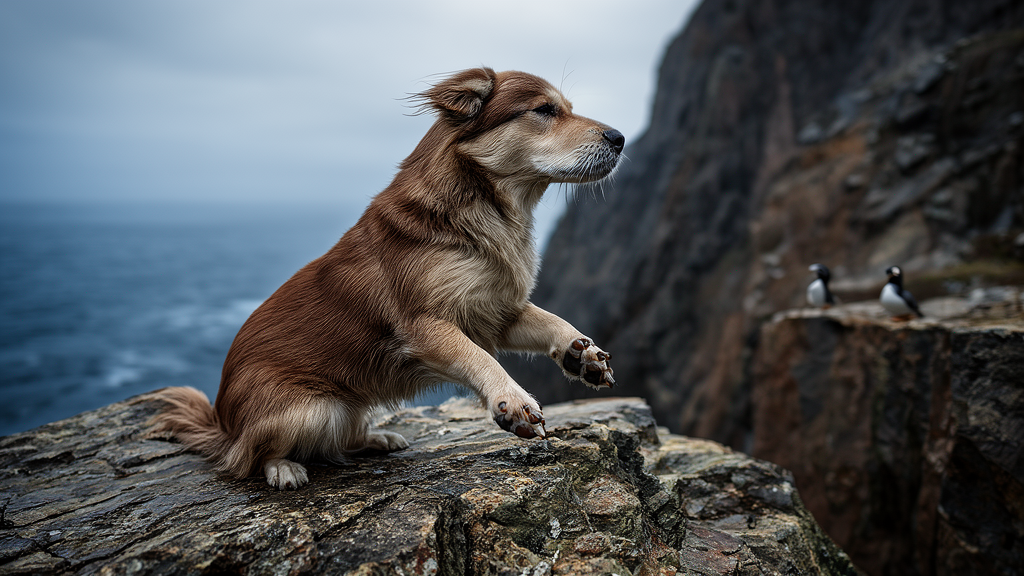
Fewer than 100 Norwegian Lundehunds survived World War II. The breed nearly vanished because its unique anatomy made it nearly impossible to breed in a post-war world that valued standard paws. The six-toed foot, the flexible shoulders, the ability to close its ears, these were not decorative quirks. They were the exact adaptations required to hunt puffins on the steep cliffs of Norway. When the breed was nearly wiped out, those very traits that made them exceptional working dogs became the reason they were nearly extinct.
The Norwegian Lundehund is not a breed you encounter at a typical dog show. It is a breed that looks like an evolutionary answer to a single, highly specific question: how do you catch a bird that lives on vertical rock faces, digs into narrow tunnels, and flies away at the sound of a footstep?
Most dogs have four toes. The Lundehund has six. The extra digit sits higher on the leg, a dewclaw that functions as a thumb. It does not drag. It does not get in the way. It grips. When a Lundehund drops into a puffin burrow, that extra toe braces against the rock wall while the front paws dig. The dog does not squeeze into the tunnel. It anchors itself and reaches.
The breed’s anatomy is not merely unusual. It is extreme. The shoulders can rotate 180 degrees. The neck can bend backward until the head rests against the spine. The ears can close completely, shutting out wind, rain, and the sharp cries of seabirds. The lungs can compress, allowing the dog to hold its breath longer than most breeds. The intestines can dilate, permitting the dog to fast for weeks without starving. These are not random mutations. They are the direct result of selective breeding for a single purpose: puffin hunting on the Norwegian coast.
Understanding the Lundehund requires understanding the puffin. Atlantic puffins nest in colonies along the steep cliffs of Norway, Iceland, and the North Atlantic. They dig burrows into the soil, often less than a meter deep. The burrows are narrow, winding, and end in a small chamber. A dog with standard paws cannot enter. A dog with standard shoulders cannot reach. A dog with standard ears cannot work in the wind. The Lundehund was bred to solve all three problems simultaneously.
The breed’s history is not a story of gradual refinement. It is a story of near-extinction and desperate recovery. The Lundehund was once common along the western coast of Norway. Farmers needed dogs that could hunt puffins for food and feathers. The dogs were small, agile, and built for vertical terrain. They were not bred for speed or strength. They were bred for precision and flexibility.
World War II changed everything. The German occupation of Norway disrupted breeding programs. The dogs were scattered. The breed’s population collapsed. By 1960, fewer than 100 purebred Lundehunds remained. The dogs that survived were often mixed with other breeds, diluting the unique anatomical traits that defined the Lundehund. The breed was no longer recognized as distinct. It was no longer useful. It was nearly gone.
The recovery began in 1963, when a group of Norwegian breeders located the remaining purebred lines. They identified dogs with the six toes, the flexible shoulders, the closable ears. They began a careful breeding program, prioritizing anatomical integrity over appearance. The goal was not to create a show dog. The goal was to preserve a working breed that could still perform its original function.
The result is a dog that defies standard canine anatomy. The Lundehund’s six toes are not a genetic anomaly. They are a functional adaptation. The extra digit, called a dewclaw, is positioned higher on the leg than in most breeds. It does not touch the ground when the dog walks. It engages only when the dog needs to grip. In a puffin burrow, that grip is the difference between reaching the bird and falling back.
The shoulders are even more remarkable. In most dogs, the shoulder blade is fixed to the rib cage by muscle and ligament. The Lundehund’s shoulder blades are not attached to the sternum. They are held in place only by muscle. This allows the shoulders to rotate 180 degrees, enabling the dog to plant its front paws on either side of a narrow burrow entrance while keeping its body aligned. The dog does not twist. It does not strain. It positions itself with mechanical precision.
The neck follows a similar logic. The Lundehund can bend its neck backward until its muzzle touches its spine. This allows the dog to look straight up into a vertical burrow without moving its body. The dog does not have to climb. It does not have to squeeze. It simply looks down and reaches.
The ears close completely. This is not a trick. It is a protective mechanism. Puffin colonies are loud. The wind on the cliffs is constant. The Lundehund’s ears can seal shut, blocking out noise and debris. The dog can work for hours without irritation. The ears do not droop. They do not flap. They close like shutters.
The lungs compress. The intestines dilate. These are not quirks. They are survival adaptations. Puffin hunting is unpredictable. A dog may spend hours searching for a single burrow. A dog may go days without food. The Lundehund’s ability to compress its lungs allows it to hold its breath longer, useful when navigating narrow tunnels. The ability to dilate its intestines allows it to fast without starving. These traits are not rare. They are essential.
Modern Lundehunds rarely hunt puffins. The birds are protected in most regions. The dogs are kept as companions, show dogs, and therapy animals. The breed’s unique anatomy does not disappear with its original purpose. It remains. The six toes, the flexible shoulders, the closable ears, the compressible lungs, the dilatable intestines, these are not vestigial. They are functional. They are the breed’s identity.
Owners of Lundehunds must understand that their dog’s anatomy is not a curiosity. It is a legacy. The breed’s health issues are directly tied to its unique physiology. The most common is Lundehund Syndrome, a form of chronic inflammatory bowel disease that affects a significant portion of the breed. The disease is not fully understood. It may be linked to the breed’s dilatable intestines, which may be more susceptible to immune-mediated reactions. The disease is manageable with diet and medication, but it requires vigilance.
Another health concern is patellar luxation, a condition where the kneecap slips out of place. This is not unique to the Lundehund, but it appears more frequently in the breed, possibly due to the breed’s compact structure and high activity level. Regular veterinary check-ups can catch this early, and surgical correction is highly successful when needed.
The breed’s flexibility can also lead to joint issues, particularly in the shoulders and hips. The 180-degree shoulder rotation, while functional for hunting, places unique stress on the joint structures. Responsible breeders screen for hip dysplasia and elbow dysplasia, but owners must still be mindful of overexertion, especially in puppies whose bones are still developing.
Despite these health considerations, the Lundehund is generally a robust breed with a lifespan of 12 to 14 years. The breed’s intelligence is high, and its trainability is strong, though it requires a handler who understands the breed’s independent streak. The Lundehund is not a dog that obeys blindly. It is a dog that evaluates. It is a dog that works because it chooses to, not because it is forced to. This independence is not stubbornness. It is the remnant of a working dog that had to make split-second decisions on unstable terrain.
The breed’s coat is double, with a soft undercoat and a coarse outer coat. The coat sheds seasonally, but not heavily. The breed does not require frequent grooming, but regular brushing helps remove loose hair and distributes natural oils. The coat’s texture is weather-resistant, a trait that served the breed well on the exposed Norwegian cliffs.
The Lundehund’s size is small. Males stand 12 to 14 inches at the shoulder. Females are slightly smaller. The breed weighs between 9 and 13 pounds. This compact size is not a flaw. It is an adaptation. A small dog can enter narrow burrows. A small dog can navigate steep terrain with agility. A small dog is less likely to disturb a nesting colony.
The breed’s temperament is alert, active, and affectionate. The Lundehund bonds closely with its family but is reserved with strangers. The breed is not aggressive, but it is watchful. The breed is not hyperactive, but it requires daily exercise. The breed is not lazy, but it is not a jogging partner. The breed is a companion that thrives on mental stimulation as much as physical activity.
Training a Lundehund requires patience and consistency. The breed responds best to positive reinforcement and short, engaging sessions. The breed does not respond well to repetition or harsh correction. The breed learns quickly when the task is interesting. The breed struggles with boredom. The breed needs variety. The breed needs purpose.
The breed’s history is not a footnote. It is the foundation. The breed’s anatomy is not a novelty. It is the reason the breed exists. The breed’s recovery is not a miracle. It is the result of deliberate, careful breeding. The breed’s future depends on preserving its unique traits, not diluting them for show rings or novelty.
The Norwegian Lundehund is not a breed for everyone. It is a breed for those who understand that uniqueness is not a flaw. It is a breed for those who value function over form. It is a breed for those who recognize that a dog’s history is written in its bones.
The six toes are not extra. They are essential. The flexible shoulders are not unusual. They are necessary. The closable ears are not a trick. They are protection. The compressible lungs are not a curiosity. They are survival. The dilatable intestines are not a weakness. They are adaptation.
The Lundehund is a living archive of Norwegian coastal history. It is a testament to selective breeding at its most precise. It is a reminder that dogs are not generic. They are specific. They are shaped by their purpose. They are defined by their function.
The breed’s story is not over. It is continuing. The breed’s future is in the hands of owners who understand its past. The breed’s value is not in its rarity. It is in its uniqueness. The breed’s legacy is not in its numbers. It is in its anatomy.
The Norwegian Lundehund is not a breed you forget. It is a breed you remember. It is a breed that proves dogs are more than four legs and a tail. It is a breed that proves history is written in bone.