
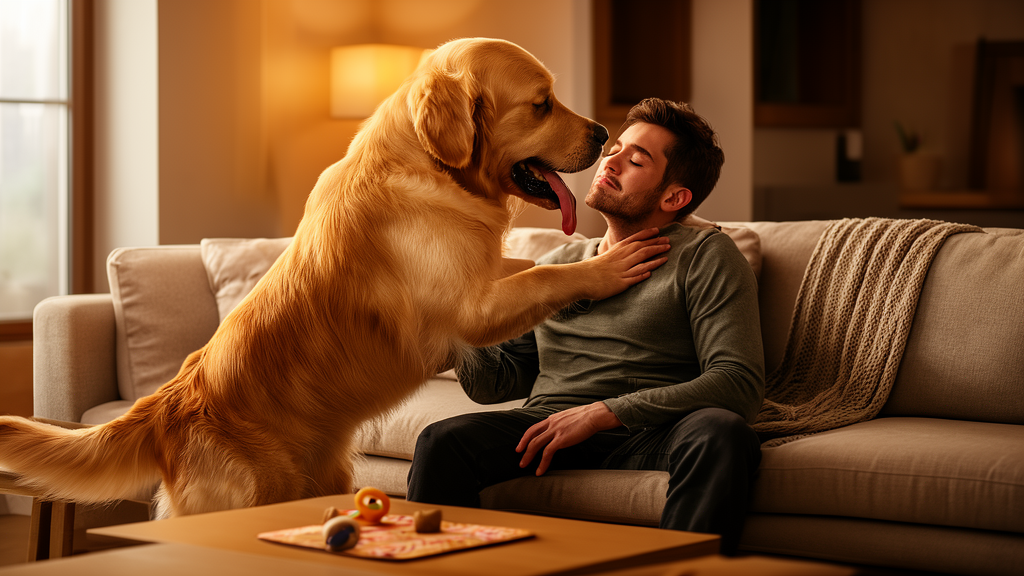
You’re sitting on the couch, scrolling through your phone, and a wet nose presses firmly into your chin. Before you can react, a broad, sloppy tongue sweeps across your cheek. You laugh, you shoo it away, and three seconds later, the tongue is back. This is the single most common way your dog greets you, and you’ve probably never stopped to ask what it actually means.
Your dog isn’t trying to be annoying. They aren’t grooming you because they think you’re another dog. The behavior is rooted in puppyhood, survival, and a specific set of sensory signals that your dog’s brain interprets as home. Here is what the ethology actually says about face-licking, and why your dog keeps coming back for more.
The Puppyhood Origin: Why Licking Starts Before Adoption
Every dog starts life licking. It is the primary way a newborn puppy communicates with its mother. Within the first few days of life, puppies lick the mother’s lips and muzzle to trigger regurgitation. This isn’t a cute trick; it is the exact biological signal that tells the mother dog to bring up partially digested food for the litter. Puppies that lick harder, faster, and more persistently get fed first. It is one of the earliest, most hardwired behaviors a dog will ever learn.
When you adopt a puppy, you don’t just get a dog. You get a dog whose first survival instinct is to lick your face. The behavior doesn’t disappear when they grow up. It just gets repurposed.
As the dog matures, the regurgitation trigger fades, but the motor pattern remains. Licking your face becomes a social signal. It is a greeting. It is a request. It is a way of checking in. And because you respond to it (usually with laughter, a shooing motion, or a gentle push), the behavior gets reinforced. Your dog learns that licking your face gets a reaction. Reactions are rewards, even if the reaction is just you moving your head.
Sensory Science: What Your Dog Actually Tastes
If you’ve ever wondered why your dog targets your face specifically, the answer lies in your skin. Your face, your neck, and your hands are the saltiest parts of your body. Dogs have roughly 2,200 taste buds. Humans have roughly 9,000. Dogs don’t need high-resolution taste. They need high-salt detection, and your face delivers exactly that.
When you sweat, when you’ve been outside, when you’ve just washed your face with a salty cleanser, your dog’s tongue is picking up on sodium, minerals, and trace proteins. They are literally tasting you. This isn’t a metaphor. It is olfactory and gustatory data feeding directly into the brain’s reward centers. A salty face is a high-value target for a dog’s tongue.
But it goes deeper than salt. Your face carries your scent. Dogs experience the world primarily through smell, and your face is one of the most concentrated sources of your unique odor profile. When your dog licks your face, they are reading your current emotional state, your recent activities, and your health status. They are checking in. They are gathering data. And they are doing it in the most direct way possible.
Why Your Dog Won’t Stop (Even When You Shoo Them)
Here is the uncomfortable truth: every time you laugh and push your dog’s face away, you are reinforcing the behavior. You are giving them attention. Attention is a reward. Dogs are incredibly good at reading human reactions, and they have learned that face-licking works. It gets you to look at them. It gets you to talk to them. It gets you to move.
Even negative reactions can be rewarding. If your dog licks your face and you say “no” in a sharp voice, they have successfully made you react. They have successfully controlled your behavior. That is a powerful outcome for a dog who wants to connect with you.
This is why face-licking becomes compulsive in some dogs. It is a self-reinforcing loop. The dog licks. You react. The dog learns that licking controls your attention. The dog licks more. You react more. The cycle tightens until the dog is licking your face every time you sit down, every time you come home, and every time you look at them.
When Face-Licking Becomes a Problem
Most face-licking is harmless. It is a social signal, a greeting, and a way of checking in. But in some dogs, it crosses into compulsive territory. If your dog is licking your face to the point of causing skin irritation, if they cannot stop even when you leave the room, or if the behavior is accompanied by other compulsive patterns (pacing, tail-chasing, flank-sucking), you are looking at a behavioral issue that goes beyond simple affection.
Compulsive licking in dogs is often a symptom of underlying stress, anxiety, or boredom. It is a coping mechanism. The dog is self-soothing through the repetitive motion of licking, which releases endorphins. When the dog is anxious, stressed, or under-stimulated, the licking increases. It is not a choice. It is a physiological response to discomfort.
If your dog’s face-licking has crossed into compulsion, the solution is not to yell at them or push them away harder. The solution is to address the underlying cause. More exercise. More mental stimulation. More environmental enrichment. A veterinary check to rule out pain or gastrointestinal issues. And, if necessary, a behavior modification plan built around counter-conditioning and redirection.
How to Stop Face-Licking (Without Damaging Trust)
If you want to stop your dog from licking your face, you need to do three things. First, stop reinforcing the behavior. Every time you laugh, shoo, or push your dog’s face away, you are rewarding them. You need to become boring. Turn your head. Look away. Cross your arms. Do not make eye contact. Do not speak. Do not move. Make yourself an unrewarding target.
Second, redirect the behavior. When your dog goes for your face, give them an alternative. A chew toy. A lick mat. A puzzle feeder. Something that satisfies the same oral fixation without targeting your skin. Reward the alternative heavily. Praise them. Give them attention. Make the alternative more rewarding than your face.
Third, manage the environment. If your dog licks your face when you come home, do not let them get close to your face for the first five minutes. Keep them on a leash. Keep them in a crate. Keep them in another room. Manage the access until the behavior drops. Dogs are opportunistic. If the behavior stops being rewarded, it will eventually extinguish. But only if you are consistent.
This is not about dominance. It is not about establishing yourself as the leader. It is about breaking a self-reinforcing loop that your dog has learned works. Your dog is not trying to be annoying. They are trying to connect with you. They just need a different way to do it.
What the Research Actually Says About Dog Licking
The science behind dog licking is surprisingly well-documented. A 2013 study published in the journal Applied Animal Behaviour Science by researchers at the University of Lincoln found that dogs lick their owners significantly more often than they lick other objects in the room. The licking was not random. It was targeted. It was directed at the owner’s face and hands. The researchers concluded that licking is a social signal used to elicit attention and reinforce the human-dog bond.
Another study, published in Frontiers in Veterinary Science in 2021, found that dogs lick their owners’ faces more frequently when the owners are looking at them. The licking increases when eye contact is made. The researchers suggest that licking is a bidirectional social signal, used by both dogs and humans to reinforce attachment. Dogs lick when they want attention. Humans smile when they are licked. The cycle reinforces itself.
The research is clear: face-licking is not aggression. It is not dominance. It is not a sign of poor training. It is a hardwired social signal that your dog uses to connect with you. Whether you like it or not, it is part of your dog’s vocabulary. The question is whether you want to keep speaking that language.
Frequently Asked Questions
Is it safe for my dog to lick my face?
Generally, yes. Dog mouths are not as dirty as people assume. However, if you have open wounds, recent surgery, or a compromised immune system, you should prevent face-licking. Dogs can carry bacteria like Capnocytophaga canimorsus, which is normally harmless but can cause serious infections in immunocompromised individuals.
Why does my dog lick my face but not my hands?
Your face is saltier than your hands. Your face carries more of your unique scent profile. Your face is closer to your dog’s nose when you are sitting together. Your dog is targeting the most concentrated source of your sensory data.
Can face-licking be a sign of illness in my dog?
Yes. If your dog suddenly starts licking your face excessively, it could be a sign of nausea, gastrointestinal discomfort, or anxiety. Dogs often lick when they feel unwell. If the behavior is new, sudden, or compulsive, a veterinary check is warranted.
How long does it take to stop face-licking?
It depends on how long the behavior has been reinforced. If your dog has been licking your face for years, it will take weeks or months to extinguish. Consistency is key. If you give in once, you reset the clock. Most owners see significant improvement within four to six weeks of strict management and redirection.