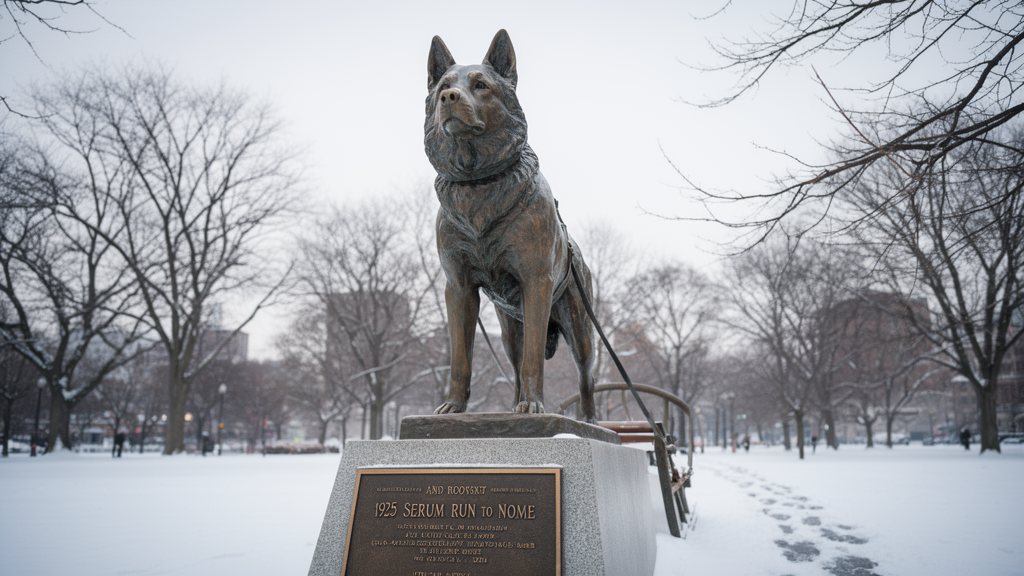
A single sled dog ran 14 miles into a blizzard to save a town. That is the story on the bronze statue in Central Park. The real story is a 674-mile relay that required 20 dogs, 20 mushers, and a week of whiteout conditions to deliver diphtheria antitoxin to a quarantined town in Alaska. The serum arrived 12 hours before it would have been too late. The children of Nome were saved, and the world learned that working dogs were not just beasts of burden, but the only thing standing between a town and total extinction.
The 1925 serum run to Nome is one of the most famous episodes in canine history, but the reality behind the statue is far more complex, and far more fascinating, than the single-dog myth suggests. Balto was the lead dog of the final team, but he was not the only one. He was the last link in a relay of 20 dogs and 20 mushers, working through a week of sub-zero temperatures and whiteout blizzers to keep a lifeline open to a town cut off by sea ice.
Understanding the serum run requires looking past the hero worship of a single animal and examining the actual mechanics of the relay, the specific breeds that made it possible, and the historical context of why a small town in Alaska was so vulnerable to a disease that had been largely controlled in the lower 48.
The Anatomy of a Relay
The serum run was not a single marathon. It was a relay. The 674-mile journey from Nenana to Nome was broken into 20 legs, each roughly 25 to 40 miles long. Each leg was run by a different musher, leading a different team of dogs. The dogs did not run the entire distance. They ran one leg, then were swapped out, rested, fed, and given water before the next team took over.
This relay system was the only way to move the serum fast enough. A single team running 674 miles would have died long before reaching Nome. By rotating teams, the serum could be moved at an average speed of 12 miles per hour, which was blistering for the conditions.
The breeds involved were not random. The teams were composed primarily of Alaskan Huskies, a landrace of working dogs bred specifically for speed, endurance, and the ability to run in extreme cold. These dogs were not purebred in the modern sense. They were a mix of breeds, including Siberian Huskies, Malamutes, and local working dogs, selected purely for their performance on the trail.
The dogs’ physiology was the real hero. Their thick double coats, padded feet, and efficient metabolism allowed them to run for hours without stopping. They could regulate their body temperature, shivering to generate heat when the wind chill dropped below 50 degrees below zero. They could also conserve water by metabolizing the fat in their food, which meant they didn’t need to melt snow for drinking water, saving precious time and energy.
The Real Heroes: Togo and Balto
While Balto gets all the credit in New York, the historical record points to a different dog as the true hero of the relay: Togo the Sled Dog: The 114-Mile Leg That Actually Saved Nome, the lead dog of musher Leonhard Seppala.
Seppala was tasked with running the most dangerous leg of the relay: 110 miles across the treacherous Norton Sound, a body of water that was freezing over. The ice was unstable, and the dogs had to navigate open water, thin ice, and deep snowdrifts. Togo ran 110 miles, more than any other dog in the relay, and covered the most difficult terrain.
When the ice gave way, Togo leaped across a gap to reach solid ground, saving the serum. He was the dog that actually delivered the life-saving medicine to the next team. Balto, by contrast, ran the final 14 miles into Nome, a much shorter and less dangerous leg.
Why does Balto get the statue, and Togo gets nothing? The answer lies in politics, not performance. Seppala was a Norwegian immigrant, and Balto was a mixed-breed dog with no pedigree. The city of New York wanted a hero they could market, and Balto, who was already famous for his final run, fit the bill. Seppala, meanwhile, was busy working his dogs and didn’t care about the fame. He sold Balto to a Cleveland zoo for $1,000, a fraction of what the dog was worth to the city.
Togo was forgotten entirely. He was euthanized in 1931, his body stuffed and placed in a museum in Norway. It wasn’t until 2010, when a documentary team rediscovered his story, that the world learned about the dog who actually ran the hardest leg of the relay.
The Historical Context: Why Nome Needed the Serum
To understand the serum run, you have to understand the isolation of Nome. Located on the Seward Peninsula, Nome was cut off by sea ice from November to May. There were no roads, no trains, no airplanes. The only way in or out was by dog sled or ship during the brief summer.
In late 1924, a young boy named William Anderson fell ill with diphtheria. The town doctor, John Helzer, diagnosed the disease and ordered an antitoxin from a lab in San Francisco. The serum was shipped by train to Seattle, then by ship to Nome. But the ship was delayed by ice, and the serum didn’t arrive until February 1925, by which time 15 children had already died.
Diphtheria is a bacterial infection that causes a thick coating in the back of the throat, making it difficult to breathe and swallow. In children, it can be fatal within 48 hours. The antitoxin was the only treatment, and Nome was running out.
When the train from Nenana reached the town, the local doctor realized that the serum was not enough. They needed more. They contacted the Department of Public Health in Washington, D.C., which authorized the release of 20 vials of antitoxin. The serum was loaded onto a train and headed for Nenana, the terminus of the Alaska Railroad.
From Nenana, the serum had to be moved by dog sled to Nome. The distance was 674 miles. The weather was terrible. The wind was blowing at 100 miles per hour. The temperature was 50 degrees below zero. The dogs had to run through blizzards, whiteouts, and open water.
The relay was organized by Dr. Wilhelm Stromberg, the local doctor in Nome, and Dr. Curtis Anderson, the territorial health officer. They knew that if the serum didn’t arrive in time, more children would die. They contacted the Department of Public Health, which authorized the release of the serum. The serum was loaded onto a train and headed for Nenana.
The relay was a masterpiece of logistics. The mushers were chosen for their experience, their dogs were chosen for their performance, and the serum was protected in insulated containers to prevent it from freezing. The dogs ran through the night, guided by the stars and the wind, knowing that the lives of children depended on them.
The Legacy of the Serum Run
The serum run to Nome changed the way we think about dogs. Before 1925, dogs were seen as tools, beasts of burden, or pets. After 1925, they were seen as partners, as heroes, as members of the family.
The run also changed the way we think about public health. It showed that in remote areas, the only way to deliver medical care was by dog sled. It led to the creation of the Alaska Territorial Guard, a network of dog sled messengers who delivered mail, medicine, and supplies to remote villages.
The run also led to the creation of the Iditarod Trail Sled Dog Race, an annual race that follows the route of the serum run. The race is a tribute to the dogs and mushers who made the run possible, and a celebration of the spirit of the North.
But the most important legacy of the serum run is the story itself. It is a story of courage, of sacrifice, of the bond between humans and dogs. It is a story that reminds us that even in the darkest times, there is always a way forward, as long as we have the dogs to guide us.