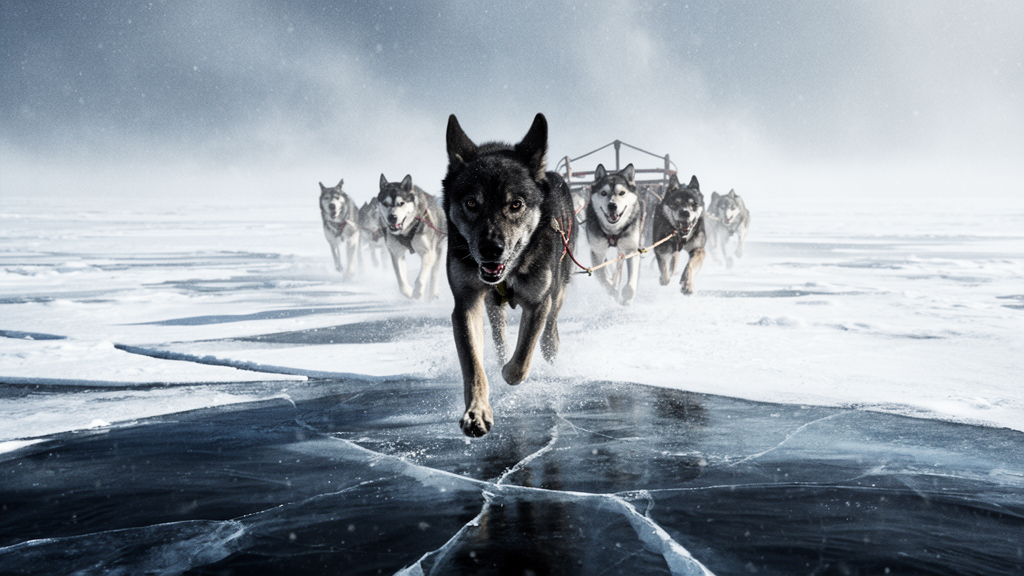
You’ve been told the 1925 serum run to Nome was one dog’s heroic dash. It wasn’t. The story you remember is clean, simple, and completely wrong. The run was a relay of 20 teams covering 674 miles through a blizzard, and the dog who actually ran the hardest, most dangerous leg was not Balto. It was Togo, a mixed-breed sled dog who carried the serum across treacherous Norton Sound, a stretch of open water that killed more sled dogs than any other part of the route. Balto only ran the final leg into town. The history books gave him the statue because he was the last dog. The working history gives Togo the credit for saving the town.
This is not a correction for the sake of correction. It is a correction that changes how we understand working dogs, selective breeding, and the actual mechanics of a sled dog team. When we look at The 674-Mile Relay That Saved Nome: The 1925 Serum Run, we are not looking at a single act of bravery. We are looking at a masterclass in logistics, canine physiology, and the specific traits that make a dog capable of extreme endurance work. And at the center of that story is Leonhard Seppala, the Norwegian musher who trained Togo, and the specific genetic and behavioral traits that allowed a dog most people dismissed as a mutt to perform one of the most demanding feats in working dog history.
The 674-Mile Relay That Actually Saved Nome
In January 1925, diphtheria broke out in Nome, Alaska. The town’s supply of antitoxin was running out, and the nearest supply was in Nenana, 674 miles away. The rail line ended in Nenana. From there, the serum had to be carried by dog sled teams through a blizzard that was actively raging. The temperature dropped to -50 degrees Fahrenheit. Visibility was zero. The lead musher, Gunnar Kaasen, was following Balto into Nome, but he was not the one who had carried the serum across the most dangerous section of the route.
The relay involved 20 teams. Each team carried the serum for roughly 30 to 50 miles, passing it to the next team at designated checkpoints. The serum was kept in a wooden box, insulated with wool blankets, and carried on the back of the lead sled. The dogs ran in a fan formation, with the lead dog setting the pace and the rest of the team following in his tracks, breaking the wind and the snow. This is not a romanticized image. This is the exact working formation used by Arctic indigenous peoples for centuries, and it is the only way to move heavy loads over deep snow without exhausting the animals.
Togo’s leg was 114 miles long, the longest of any team in the relay. But it was not the length that made it dangerous. It was the terrain. Togo had to cross Norton Sound, a 10-mile stretch of open water between the Seward Peninsula and the mainland. The ice was thin, cracking under the weight of the sled, and the wind was pushing the dogs toward the open water. If the ice gave way, the serum would be lost, and the dogs would drown. Togo did not just cross the sound. He led his team across it three times, because the ice was too thin to support the full weight of the sled and the serum on a single crossing. He broke the ice, swam through the open water, and led his team back to the solid ice, repeating the process until the serum was safely across. No other dog in the relay faced this specific, lethal combination of conditions.
Why Togo Was Not Just a Mutt
Togo was not a purebred. He was not a Siberian Husky, and he was not a Malamute. He was a mixed-breed dog, the offspring of a Siberian Husky and a wolf-dog hybrid. Most people today look at a mixed-breed dog and see a pet. In 1925, Leonhard Seppala looked at Togo and saw a working dog. Seppala was a Norwegian musher who had moved to Alaska to work with sled dogs, and he had a very specific idea of what a working dog should be. He did not care about pedigree. He cared about performance. He cared about the dog’s ability to read the terrain, to make decisions on his own, and to push through conditions that would break a less capable animal.
Togo had a high prey drive, which is the instinct to chase and hunt small animals. This is not a flaw in a working dog. This is the engine that drives a dog to run for hours without stopping. Togo also had a high pain tolerance, which allowed him to run through injuries that would have stopped a less driven dog. He had a thick double coat, which is not a shedding problem, but a climate regulator that allowed him to maintain his body temperature in sub-zero conditions. He had a strong pack instinct, which allowed him to work seamlessly with his team, reading their movements and adjusting his pace to keep the team together. These are not random traits. These are the exact traits that Seppala selectively bred for when he was building his team.
Seppala’s breeding program was not about creating a pretty dog. It was about creating a dog that could perform specific tasks in specific conditions. He bred for endurance, for intelligence, for independence, and for the ability to make split-second decisions on the trail. Togo was the product of that breeding program. He was not an accident. He was the result of deliberate, selective breeding that prioritized working ability over appearance. When Seppala died, he left behind a legacy of dogs that were not just pets, but working partners. Togo was the best of them.
The Working Purpose Behind Togo’s Traits
Every working breed has a specific purpose. The Border Collie was bred to herd sheep. The Basenji was bred to hunt in silence in Central Africa. The Norwegian Lundehund was bred to hunt puffins on steep cliffs. Togo’s purpose was to carry heavy loads over long distances in extreme cold, and to do it without stopping. This is not a hobby. This is a survival skill. For the indigenous peoples of the Arctic, a dog that could do this was not a luxury. It was a necessity. A dog that could not handle the cold, the distance, or the terrain was a liability. A dog that could was a partner.
Togo’s traits were not random. They were the result of thousands of years of selective breeding. The Siberian Husky was bred by the Chukchi people of Siberia for exactly this purpose. They were bred for speed, for endurance, and for the ability to work in a team. The wolf-dog hybrid added a layer of independence and problem-solving ability that purebred dogs often lack. Togo was the perfect combination of these two lines. He had the speed and endurance of the Husky, and the independence and problem-solving ability of the wolf-dog. He was not just a dog. He was a tool. And like any tool, he was designed for a specific purpose.
When we look at Togo, we are not looking at a single dog. We are looking at the result of a specific breeding program, a specific working purpose, and a specific set of environmental conditions. He was not an accident. He was the product of deliberate, selective breeding that prioritized working ability over appearance. When Seppala died, he left behind a legacy of dogs that were not just pets, but working partners. Togo was the best of them.
What the 1925 Serum Run Teaches Us About Working Dogs
The 1925 serum run is not just a historical event. It is a case study in working dog physiology, behavior, and breeding. It teaches us that working ability is not random. It is the result of deliberate, selective breeding that prioritizes specific traits over others. It teaches us that a dog’s working purpose shapes its behavior, its physiology, and its temperament. It teaches us that a mixed-breed dog can be just as capable as a purebred dog, if it has the right traits. And it teaches us that the history of working dogs is not just about famous dogs. It is about the dogs that did the work, even when no one was watching.
Togo did not get the statue. Balto did. But Togo got the work. And the work was harder. When we look at working dogs today, we should not just look at the famous ones. We should look at the dogs that do the work. We should look at the dogs that have the right traits for the job. And we should remember that working ability is not random. It is the result of deliberate, selective breeding that prioritizes working ability over appearance. Togo was not just a dog. He was a working partner. And he earned his place in history, even if the history books got his name wrong.