Your dog is standing three feet from the fence, muscles locked, teeth bared, and the mail carrier is still walking up the driveway. You know the drill. You yank the leash, you press them back, you wait for the mail carrier to disappear, and you tell yourself your dog is just aggressive. But what if it isn’t? What if your dog is actually exhausted from trying to control a situation they can’t control, and the barking is the only tool left in their toolbox?
This is not a personality flaw. It is a learned helplessness loop. And it is the single most common reason dogs end up in shelters for ‘aggression.’ When you pull the leash back, you are not teaching your dog to be calm. You are teaching them that their own signals do not matter, so they escalate until you physically stop the trigger. The next time the trigger appears, they start at a higher intensity because they learned that low-intensity signals were ignored.
Understanding this loop changes everything. It means the solution is not to suppress the behavior, but to change the dog’s relationship with the trigger before the trigger even appears. Let’s look at how the loop forms, why suppression makes it worse, and how to break it without ever touching the leash again.
The Three Stages of the Loop
Every reactive dog runs through the same three stages. The first is the signal stage. The dog sees the trigger (a person, another dog, a bicycle) and sends a clear signal: a stiff body, a fixed stare, a low growl. This is a request for space. It is a perfectly normal, biologically sound communication. The dog is saying, ‘I am uncomfortable. Please move on.’
The second stage is the suppression stage. The owner yanks the leash, applies pressure, or says ‘no.’ The dog stops the signal. They may even turn away. To the untrained eye, the dog is ‘calm.’ But physiologically, the dog is still flooded with cortisol and adrenaline. The stress hormones are still circulating. The dog has learned that showing discomfort gets punished, so they shut down. This is the moment learned helplessness begins.
The third stage is the escalation stage. The next time the trigger appears, the dog starts at the suppression stage. They do not get the chance to send a signal because the owner anticipates the trigger and pre-emptively pulls the leash. The dog learns that signals are useless. So they skip straight to the only thing that works: full-blown aggression. Barking, lunging, snapping. It is the only tool left. And because it works (the trigger goes away), it gets reinforced.
This is the loop. Signal ignored. Suppression. Escalation. Repeat. The dog does not get better. They get louder, faster, and more desperate.
Why ‘Good Behavior’ Is a Trap
Shelters and trainers often reward the suppression stage. They call it ‘calmness.’ They call it ‘self-control.’ They call it ‘good behavior.’ But a dog that has learned to suppress their signals is not calm. They are stressed. They are waiting for the next trigger to appear so they can skip the signals and go straight to the escalation.
This is why so many dogs ‘suddenly’ become aggressive after being ‘trained.’ The training taught them to suppress. It did not teach them to feel safe. The moment the leash comes off, or the moment the trigger is too strong, the dog explodes. Because they never learned that the trigger itself is not dangerous. They only learned that the leash is.
Real safety looks different. A safe dog sends a signal. The trigger moves on. The dog relaxes. The cycle is complete. The dog learns that their voice matters. The dog learns that the world is predictable. The dog does not need to escalate.
How to Break the Loop
Breaking the loop requires three steps. The first is distance. The second is replacement. The third is consistency.
Distance means keeping the dog below threshold. This is the single most important concept in reactive dog training. Threshold is the point where the dog stops thinking and starts reacting. If the dog is barking, lunging, or shaking, you are past threshold. You are too close. Step back. The dog must be able to see the trigger and still choose to look at you. If they cannot, you are too close.
Replacement means giving the dog a job. Instead of waiting for the trigger and hoping the dog will ‘be good,’ you give the dog a competing behavior that is physically impossible to do while reacting. ‘Find it.’ ‘Look at that.’ ‘Touch.’ These are not tricks. They are neurological interrupts. They force the dog’s brain to switch from ‘threat’ mode to ‘work’ mode. The dog learns that the trigger predicts good things, not bad things.
Consistency means never pulling the leash back again. When the trigger appears, you do not yank. You do not press. You step back. You create distance. You let the dog choose. If the dog looks at the trigger, you mark it and reward them for looking away. You are teaching the dog that they have control. You are teaching them that their signals work. You are breaking the loop.
The Honest Limits
This approach does not work for every dog. It does not work if the dog is in a state of chronic, unmanaged pain. It does not work if the dog has a neurological condition that causes unprovoked aggression. It does not work if the owner is inconsistent, or if the dog is exposed to the trigger daily without distance.
It also does not work overnight. Breaking a learned helplessness loop takes months, sometimes years. The dog has to rewire their nervous system. They have to learn that the world is not a place where their signals are ignored. They have to learn that they can trust their owner to keep them safe. This is not a quick fix. It is a fundamental shift in the dog’s relationship with the world.
But when it works, it works completely. The dog does not just stop barking. They stop being afraid. They start living. And that is worth the time.
What This Changes
When you stop pulling the leash, you stop teaching the dog that their voice does not matter. When you give them distance, you give them control. When you give them a job, you give them a way to cope. You are not suppressing a personality flaw. You are repairing a broken communication loop.
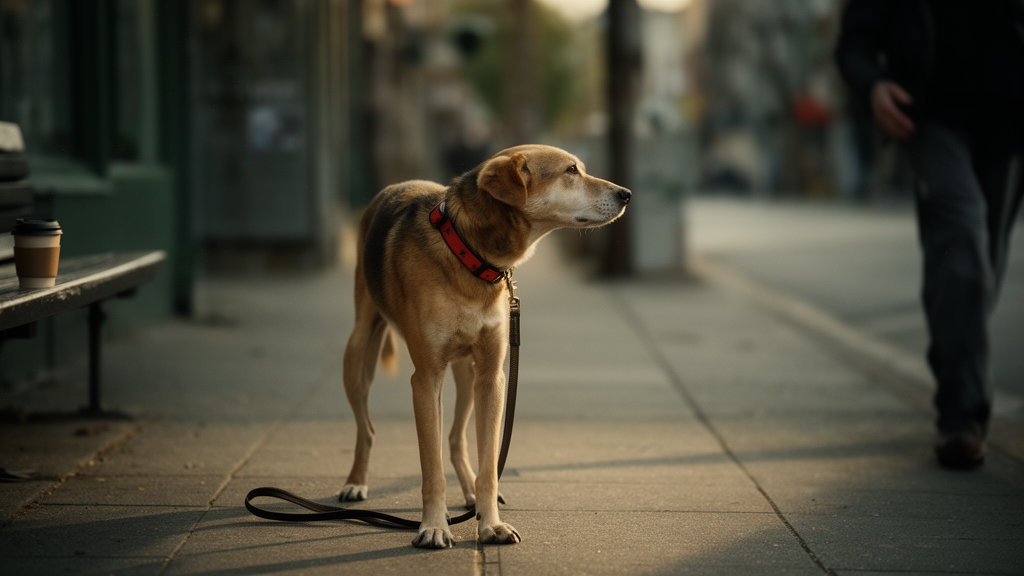
The next time your dog plants their feet on the sidewalk, do not pull. Step back. Give them space. Let them choose. Watch what happens. The loop might just break.