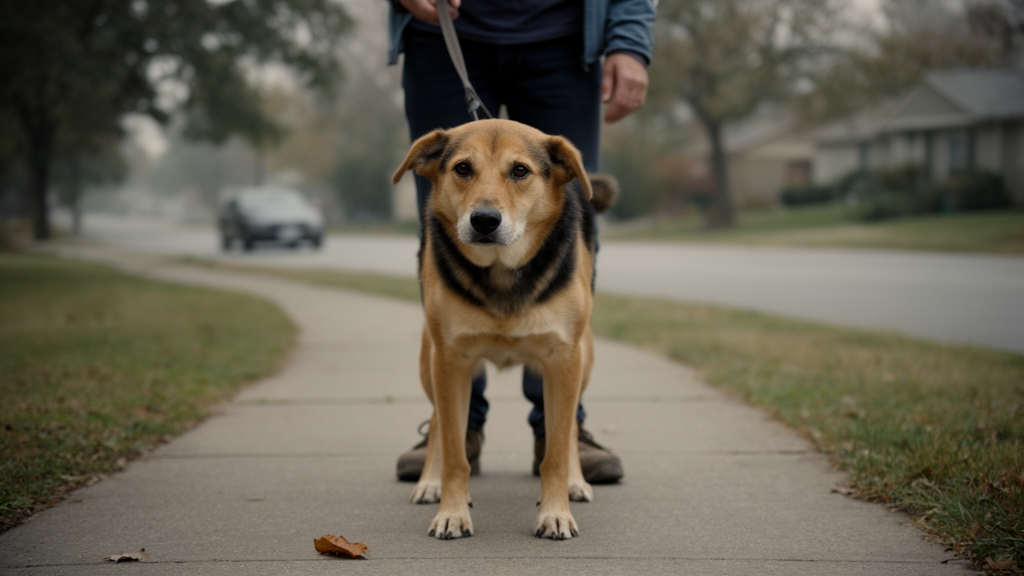
You are standing on the sidewalk, leash in hand, and your dog plants his feet. He isn’t being difficult. He isn’t being stubborn. He is standing at a threshold, and he has made a decision that you are about to learn how to read.
That moment when a dog arbitrarily refuses to walk further is not a personality flaw. It is a signal. Every dog owner has experienced it: you clip on the leash, step outside, and three paces later your dog becomes a statue. The frustration builds. You tug. He digs in. You give up and turn around. This happens every single time, and it feels like a battle of wills. It is not. It is a behavioral mechanism called the threshold, and understanding it changes everything about how you handle walks.
When a dog stops walking, he is communicating that he has crossed a line where the environment has become too much. The threshold is the invisible boundary between “I can handle this” and “I cannot handle this.” Cross it, and the dog’s nervous system shifts from exploration to overload. The refusal to move is the physical manifestation of that shift. It is not defiance. It is a hard stop triggered by anxiety, sensory overload, or fear that you cannot see from your standing height.
Recognizing the threshold requires you to stop looking at the dog and start looking at what the dog is looking at. The trigger is almost always something you cannot perceive. A distant sound. A faint scent on the wind. A shadow moving in a window. To you, the sidewalk is empty. To your dog, it is a minefield. The refusal to walk is the dog’s way of saying “I am past the point of no return.” If you pull, you confirm his fear. If you wait, you give him space to recalibrate.
The science behind this comes from ethology and behavioral psychology. When a dog reaches his threshold, his sympathetic nervous system activates. Heart rate spikes. Adrenaline floods his system. He cannot process new information. He cannot be reasoned with. He cannot be pulled. The only thing that works is reducing the load. This is not a training failure. This is biology. The dog is not choosing to be difficult. His body is choosing survival.
The solution is not to force the dog past the threshold. The solution is to identify the threshold and work below it. This means shortening the walk. This means turning around before the dog stops. This means building confidence by never crossing the line where the dog shuts down. It is slower. It feels counterintuitive. It is the only thing that works long-term.
Consider the case of a German Shepherd named Koda. Koda would walk two blocks, then plant his feet and refuse to move. His owners would tug, plead, and eventually give up. The walk would end in frustration. Then they learned about the threshold. They started watching Koda’s body language. They noticed he would stop when a specific alley came into view. They never went near that alley. They turned around. They walked a different route. Over three months, they gradually shortened the distance to the alley. Koda began walking past it. The refusal stopped. The dog was not broken. The walk was just too long.
This applies to every dog, not just rescues or anxious breeds. Even confident dogs have thresholds. A high-drive working dog might stop when the environment becomes too stimulating. A senior dog might stop because his joints ache and he cannot push through the discomfort. A puppy might stop because the world is simply too big and too loud. The mechanism is the same. The dog hits a limit. The dog stops. The dog needs you to recognize the limit and respect it.
The hardest part is resisting the urge to fix it. Your instinct is to pull, to coax, to bribe, to force. Do not. Pulling teaches the dog that his refusal is correct. It teaches him that the environment is dangerous and that you are the source of pressure. Waiting teaches the dog that you are on his side. It teaches him that you will not push him past his limit. It builds trust. It builds confidence. It builds a dog who wants to walk with you instead of walking for you.
Here is the protocol. Step one: observe. Watch your dog’s body. Does his tail lower? Does his ears flatten? Does his pace slow? These are early warnings. Step two: shorten the walk. Turn around before the dog stops. Step three: increase distance slowly. Add one block at a time. Step three: increase distance slowly. Add one block at a time. Step four: celebrate the small wins. A dog who walks three blocks without stopping is a success. A dog who walks past a trigger without planting his feet is a victory. Progress is measured in inches, not miles.
There are exceptions. If your dog stops because of pain, a vet visit is the priority. If your dog stops because of a medical condition, the threshold is physical, not behavioral. If your dog stops because of a past trauma, professional help may be necessary. But for the vast majority of dogs, the refusal to walk is a threshold issue. Respect the threshold. Shorten the walk. Trust the process. The dog will walk. He just needs you to stop pulling.
Walks are not about distance. They are about connection. When your dog stops walking, he is asking for help. He is asking you to see what he sees. He is asking you to stand with him, not push him. The next time your dog plants his feet, do not tug. Do not plead. Stand still. Wait. Watch. The threshold is not your enemy. It is your guide. Follow it, and your dog will walk with you again.
Why Does My Dog Suddenly Stop Walking?
A dog stops walking when he crosses his threshold. The threshold is the point where environmental stimuli exceed his capacity to cope. The trigger can be a sound, a scent, another animal, or a change in terrain. The dog’s body reacts with stress. He cannot move forward. He cannot move backward. He stops. This is not stubbornness. This is a physiological response to overload.
How Do I Know If My Dog Is Stressed on Walks?
Watch for early warning signs. A lowered tail. Flattened ears. A stiff body. A slow pace. A dog who is stressed on walks will show these signals before he stops. If you see them, shorten the walk. Turn around. Do not push past the warning signs. The dog is telling you he is uncomfortable. Listen to him.
Should I Pull My Dog When He Refuses to Walk?
No. Pulling confirms the dog’s fear. It teaches him that the environment is dangerous and that you are the source of pressure. It damages trust. It makes the next walk harder. Instead, wait. Stand still. Let the dog recalibrate. If he moves, reward him. If he does not, turn around. Pulling is never the answer. Waiting is.
How Long Does It Take to Fix a Dog Who Refuses to Walk?
It depends on the dog. Some dogs improve in weeks. Some take months. The timeline is determined by the depth of the threshold and the consistency of your response. If you shorten the walk every time, the threshold will gradually expand. The dog will learn that walks are safe. The dog will learn that you are on his side. The dog will walk. There is no shortcut. There is only patience.
Can I Use Treats to Get My Dog to Walk?
Treats can help, but they are not the solution. If your dog is past his threshold, treats will not work. He cannot process food when his nervous system is in overload. Use treats only when the dog is below his threshold. Offer a high-value treat. Let him eat. Then continue walking. Treats are a tool, not a fix. The fix is respecting the threshold.
What If My Dog Stops Because of Pain?
If your dog stops walking and you suspect pain, schedule a vet visit. Joint issues, back pain, and paw injuries can cause refusal to walk. A dog who stops because of pain needs medical attention, not behavioral training. If the vet rules out pain, the refusal is likely threshold-related. Follow the protocol. Shorten the walk. Wait. Trust the process.