
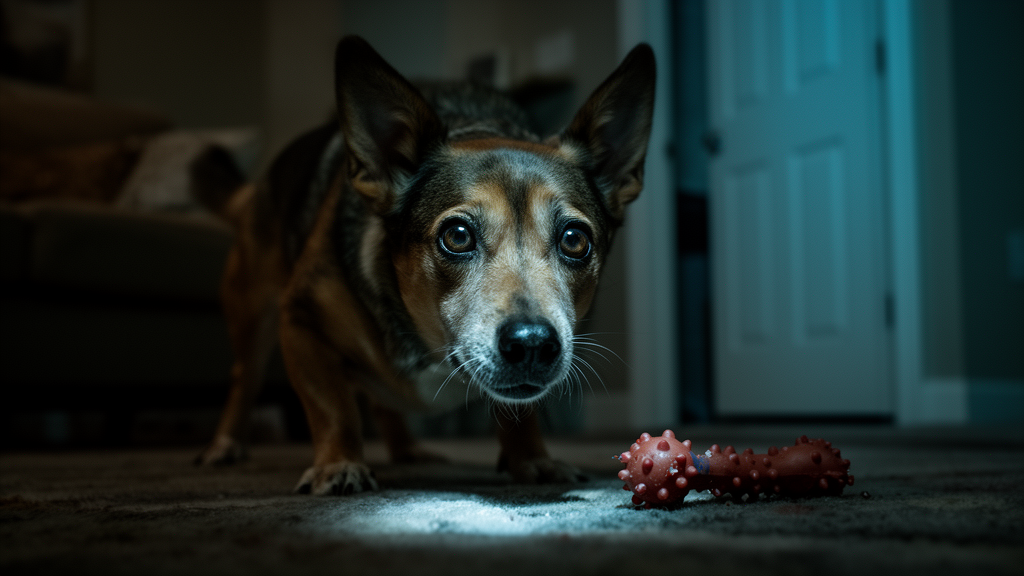
He is sitting three feet from the back door, chewing a rubber bone with the focused intensity of a bomb disposal technician. The house is quiet. The furnace is off. The refrigerator compressor has cycled down. Then the microwave clicks off with a single, sharp ding. In 0.2 seconds, the bone drops. His ears pin back. His body goes rigid, low to the ground, and he stares at the kitchen wall as if the sound itself has suddenly become a physical threat. He does not move. He does not breathe. He just waits for the next one.
This is the startle reflex, and for some dogs, it is a neurological event that hijacks their entire nervous system. We call it “reactivity,” “anxiety,” or “being jumpy.” Those words are too soft for what is actually happening. When a dog’s auditory system is wired to treat unexpected, high-frequency sounds as immediate physical threats, their brain does not process the noise. It processes survival.
Understanding this reflex changes how you interact with your dog. It stops being about fixing a behavioral flaw and starts being about managing a sensory reality. If your dog bolts at the sound of a dropped spoon, screams at fireworks, or freezes when a car backfires, you are not dealing with a disobedient pet. You are dealing with a dog whose brain has classified a specific acoustic signal as a life-threatening emergency. The goal is not to make the sound stop. The goal is to change what the sound means.
What the Startle Reflex Actually Does to the Brain
Every dog has a startle reflex. It is a hardwired, evolutionary survival mechanism designed to protect the animal from sudden physical threats. In the wild, a twig snapping behind a prey animal means a predator is closing in. The reflex triggers an immediate, involuntary response: the body tenses, the senses sharpen, and the animal prepares to either flee or freeze. This is the classic fight-flight-freeze response, mediated by the amygdala, the brain’s threat-detection center.
For most dogs, the reflex is brief. A car backfires, they flinch, and within seconds, the prefrontal cortex, the rational, decision-making part of the brain, steps in, assesses the situation, and signals that there is no actual danger. The dog relaxes, and life continues.
But for some dogs, that circuit never closes. The reflex does not fade. Instead, it amplifies. The auditory signal bypasses the rational brain entirely and goes straight to the amygdala, triggering a full-blown physiological stress response. The heart rate spikes. Adrenaline floods the system. Muscles lock up. The dog is no longer in the living room; they are in a life-or-death struggle with an invisible predator.
This is why you cannot simply tell a dog to “calm down” when they are in the grip of a startle reflex. You cannot reason with a nervous system that has already declared war. The dog is not choosing to react. They are physiologically incapable of not reacting. The sound is not a noise to them. It is a threat.
Why Some Dogs Are Wired for Hyper-Auditory Sensitivity
Not all dogs react to the same sounds, and not all dogs react with the same intensity. This variation is not random. It is rooted in genetics, early life experiences, and the specific architecture of the dog’s auditory system.
First, consider genetics. Some breeds have been selectively bred for hyper-awareness of their environment. Border Collies, German Shepherds, and Terriers were bred to detect the slightest movement or sound in a field. Their ears are not just ears; they are radar dishes. This genetic predisposition means some dogs are simply born with a lower threshold for auditory stimulation. A sound that registers as a mild annoyance to one dog registers as a siren to another.
Second, consider early life experiences. Puppies go through a critical socialization window between three and fourteen weeks of age. This is when they learn what is safe and what is dangerous. If a puppy is exposed to loud, unpredictable noises during this window without positive associations, their brain may encode those sounds as permanent threats. A vacuum cleaner that blasts during this period is not just a loud machine; it is a monster. The lesson sticks. The neural pathway is carved into the brain, and it never fades.
Third, consider the physical structure of the ear. Dogs have 18 muscles in each ear, allowing them to rotate, tilt, and focus on sounds with incredible precision. They can hear frequencies up to 65,000 Hz, far beyond the human range of 20,000 Hz. What sounds like a quiet hum to you might be a deafening roar to your dog. High-frequency sounds, like the beep of a smoke detector, the whine of a microwave, or the crack of thunder, hit them with a physical force that humans cannot comprehend.
When you combine a genetic predisposition, a traumatic early experience, and a superior auditory system, you get a dog who is hypersensitive to sound. This is not a choice. It is biology.
How to Tell If Your Dog Is in the Grip of a Startle Reflex
Most owners miss the early signs of a startle reflex because they look for aggression. They expect barking, growling, or snapping. But the reflex often manifests as freezing, hiding, or shutting down. These are not signs of a “good” dog. They are signs of a dog who has learned that fighting back is impossible, so they have chosen to disappear.
Watch your dog closely the next time a sudden sound occurs. Do their ears pin back against their skull? Do their whiskers flatten against their face? Do they lower their body to the ground, making themselves as small as possible? Do they avoid eye contact, staring at the floor or the wall? Do they pant heavily, even when they are not hot? Do they lick their lips repeatedly, a classic displacement behavior indicating stress?
If you see any of these signs, your dog is not just startled. They are in a state of acute physiological distress. Their body is flooding with stress hormones, and their brain is preparing for a fight they cannot win. Ignoring these signs, or worse, punishing them for reacting, only reinforces the belief that the sound is dangerous and that they are alone in dealing with it.
Instead, focus on what you can control. You cannot stop the world from making loud noises. But you can control your dog’s environment, and you can control how you respond when the noise happens.
Building a Sound-Safe Environment
The first step in managing a sound-sensitive dog is to reduce the frequency and intensity of the triggers. This is not about coddling; it is about giving the dog’s nervous system a chance to rest. If your dog is terrified of thunderstorms, do not force them to sit by the window. If fireworks are planned for the 4th of July, keep them in a soundproofed room with white noise. If the microwave startles them, unplug it and use a timer or a stove top.
White noise is a powerful tool. A fan, a radio tuned to static, or a dedicated white noise machine can mask the sharp, unpredictable sounds that trigger the reflex. The goal is not to eliminate all sound, but to smooth out the acoustic environment so that sudden spikes are less jarring. Think of it as putting sunglasses on for your ears.
Additionally, create a “safe zone” in your home. This should be a quiet, dark room where your dog can retreat when they feel overwhelmed. Line it with comfortable bedding, and leave a few high-value toys or chews inside. Do not force them to go there, but make it available. Over time, your dog will learn that this space is a sanctuary, a place where the world cannot reach them.
Counter-Conditioning: Rewiring the Response
Reducing triggers is management, not a cure. To truly help your dog, you must change their emotional response to the sound. This is where counter-conditioning comes in. The goal is to replace the fear response with a positive one. This takes time, patience, and consistency, but it works.
Start by finding a sound that is just below your dog’s threshold, the volume at which they notice the sound but do not yet react. This might be a recording of a thunderstorm played at a very low volume, or a video of fireworks with the sound turned down. The key is to find the exact tipping point where your dog’s ears twitch, but their body remains relaxed.
At this volume, the moment the sound plays, you mark it with a clicker or a verbal “yes,” and immediately give your dog a high-value treat. Chicken, cheese, hot dogs, whatever they love. The goal is to create a positive association: sound equals good things. Repeat this process, gradually increasing the volume of the sound over multiple sessions. If your dog shows any signs of stress, you have gone too fast. Drop the volume back down and try again.
This process is not linear. Some days will be better than others. Stormy weather, a bad night’s sleep, or a stressful day at the park can set you back. That is normal. The key is to never punish the dog for reacting. Punishment only adds more stress to an already overloaded system, reinforcing the belief that the sound is dangerous.
When to Seek Professional Help
If your dog’s startle reflex is severe, if they are destroying their environment, self-injuring, or completely unable to function in daily life, it is time to seek professional help. A certified applied animal behaviorist or a veterinary behaviorist can assess your dog’s specific needs and may recommend anti-anxiety medication to help lower their baseline stress level. Medication is not a failure. It is a tool. Just as glasses help someone see, medication can help a dog’s nervous system function well enough to learn.
Working with a professional does not mean you have failed. It means you recognize that your dog’s struggle is deeper than a simple training issue. It is a neurological and emotional challenge that requires expert guidance. The goal is not to fix your dog. The goal is to help them live a life where they are not constantly bracing for the next explosion.
When the microwave dings, your dog should not be bracing for impact. They should be chewing their bone, unaware that the world has made a sound. That is the ultimate victory. Not silence, but peace. And peace is something every dog deserves.