
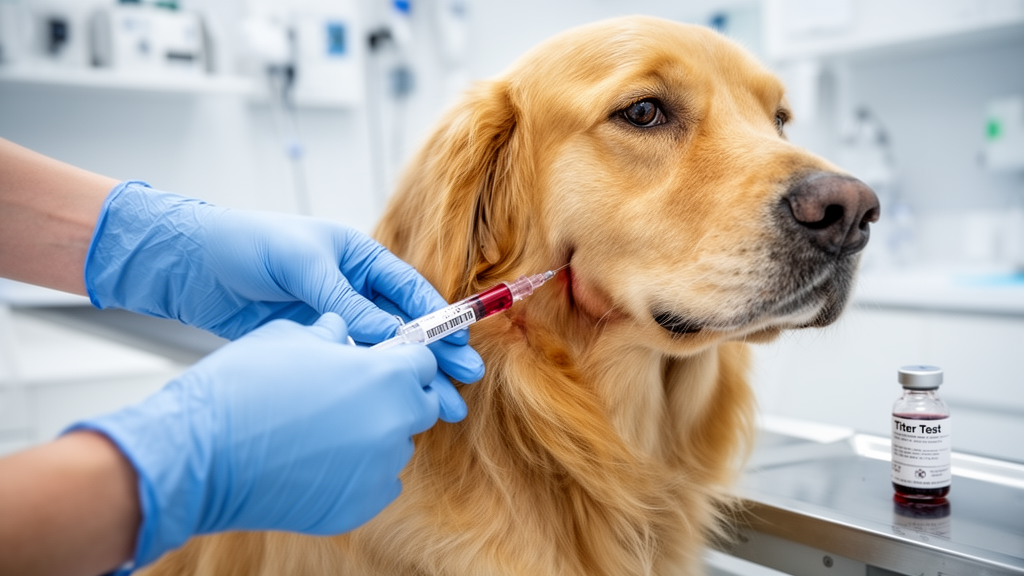
Everyone agrees your dog needs a three-year booster. The clinic stamps it, the paperwork says so, and you’ve been paying for it without question for a decade. Nobody mentions that the three-year stamp is not a biological fact. It is a legal fiction.
The answer to your dog’s actual protection level is not found in the calendar on your wall. It is found in a titer test, a simple blood draw that measures the exact concentration of antibodies your dog’s body has produced. While the veterinary industry has standardized on the three-year protocol for convenience and revenue, the biological reality is far more nuanced. Your dog may be fully protected for a decade, or they may be vulnerable after two. The calendar cannot tell you which. The blood can.
This is not an argument for ignoring vaccination. It is an argument for precision. The current system is a blunt instrument applied to individual immune systems that vary wildly in their response. By shifting from a schedule-based model to a titer-based model, we move from compliance to actual protection. This is the difference between doing what the paperwork requires and doing what the dog’s body actually needs.
The Three-Year Myth: Where the Rule Actually Comes From
The three-year booster schedule is not derived from decades of longitudinal studies showing that immunity wanes exactly at the thirty-six-month mark. It is derived from a single, pivotal one study one team, waited three years, and then challenged them with a live virus. Every single vaccinated dog survived. Every single unvaccinated dog died.
That study was groundbreaking. It proved that immunity to core diseases like distemper and parvovirus could last at least three years. It did not prove that it lasted exactly three years. But once that three-year window was established, it was adopted by the American Animal Hospital Association (AAHA) and the World Small Animal Veterinary Association (WSAVA) as the standard protocol. The nuance was lost in translation. The minimum became the maximum. The exception became the rule.
The reason this stick is so hard to move is not biology. It is liability. If a veterinarian administers a vaccine and the dog gets sick three years later, the clinic can point to the protocol. If they skip a booster based on a titer test and the dog gets sick, the clinic faces a lawsuit. The three-year stamp is a shield for the practitioner, not a guarantee for the patient. It is a compliance metric, masquerading as a medical standard.
The Titer Test: Measuring Actual Immunity
A titer test is a quantitative blood test that measures the level of circulating antibodies against specific pathogens. It does not measure the presence of antibodies, which can be non-protective. It measures the quantity of antibodies above a threshold known to provide protection. If the number is above the line, the dog is immune. If it is below, the dog needs a booster.
This is not a theoretical concept. It is a practical tool used by immunologists and forward-thinking veterinarians to individualize care. The test is widely available, relatively inexpensive, and provides a clear, binary answer: protected or not protected. There is no gray area, no guesswork, and no reliance on a calendar that has nothing to do with the dog’s actual immune history.
Consider the case of a ten-year-old Labrador. He has received a core vaccine every three years since he was a puppy. His titer test shows antibody levels ten times higher than the protective threshold. He does not need a booster. He needs no intervention. His immune system is doing exactly what it is supposed to do. Administering another vaccine to him is not just unnecessary. It is an unnecessary injection of adjuvants, preservatives, and potential side effects into a body that is already perfectly defended.
Conversely, consider a five-year-old Border Collie who has never been vaccinated due to a severe allergic reaction to the first shot. His titer test shows levels below the protective threshold. He is vulnerable. He needs a booster. The calendar would have told you he was fine. The blood tells you he is at risk. The titer test is the only way to know the truth for individual dogs whose immune responses fall outside the average.
When the Calendar Actually Matters
There are specific scenarios where the three-year rule is not just appropriate, but essential. Puppies require a series of vaccinations because maternal antibodies interfere with the immune response until they wane, typically around twelve to sixteen weeks of age. Skipping this initial series leaves a puppy completely exposed to life-threatening diseases. There is no titer test that replaces the need for this initial priming of the immune system.
Similarly, dogs with compromised immune systems due to chemotherapy, high-dose steroids, or certain genetic conditions may not mount a robust immune response to vaccination. For these dogs, a titer test might show low levels not because they are unprotected, but because their immune system is too suppressed to respond. In these cases, the veterinarian must use clinical judgment, not just a blood test, to determine the risk-benefit ratio of vaccination.
Furthermore, exposure risk varies by lifestyle. A dog that lives in a rural area with no contact with other dogs or wildlife has a vastly different risk profile than a dog that visits dog parks, attends agility competitions, or lives in a multi-dog household. For high-exposure dogs, the risk of contracting a fatal disease like parvovirus or leptospirosis is high enough that the cost of a missed booster outweighs the cost of an unnecessary vaccine. In these cases, the three-year schedule is a reasonable heuristic for safety.
The key is to recognize that the schedule is a tool, not a law. It is a useful default for dogs whose immune histories are unknown or whose exposure risks are high. But it is not a substitute for individualized assessment. For the average pet dog with a known vaccination history and low exposure risk, the schedule is often an over-application of medical intervention.
The Honest Limits of Titer Testing
Titer testing is not a perfect science. It is a snapshot in time. Antibody levels can fluctuate, and a single test may not capture the full complexity of immune memory, which includes B-cells and T-cells that can respond rapidly even if circulating antibody levels are low. However, for core diseases like distemper and parvovirus, the correlation between antibody levels and protection is so strong that titer testing is considered the gold standard by immunologists.
There is also the issue of cost and access. While titer tests are becoming more common, they are not yet universally available or covered by insurance. For many owners, the cost of a titer test is higher than the cost of a booster vaccine. This is a practical barrier that cannot be ignored. However, as testing becomes more widespread and technology improves, the cost gap is narrowing. The question is not whether titer testing is possible, but whether it is accessible.
Finally, there is the issue of veterinarian education. Many general practitioners are not trained in the nuances of immunology or the interpretation of titer results. They rely on the schedule because it is simple, familiar, and legally defensible. Shifting to a titer-based model requires a fundamental change in how veterinary medicine is practiced, from a one-size-fits-all approach to a personalized, data-driven model. This is a cultural shift that will take time, but it is a shift that is already happening.
What You Should Do Tonight
If your dog has received a core vaccine within the last three years, do not panic. Do not skip the next appointment. Instead, ask your veterinarian about a titer test. Frame it not as a refusal to vaccinate, but as a request for precision. Most veterinarians will agree that a titer test is a reasonable way to determine if a booster is necessary. If your veterinarian refuses, consider finding one who is willing to work with you on a titer-based protocol.
This is not about rejecting veterinary medicine. It is about demanding better medicine. The three-year schedule is a relic of a simpler time, when vaccines were less complex and liability was less of a concern. Today, we have the tools to individualize care. We have the data to support precision. The question is whether we have the courage to use them. Your dog’s health is not a compliance metric. It is a biological reality. Measure it, don’t guess it.