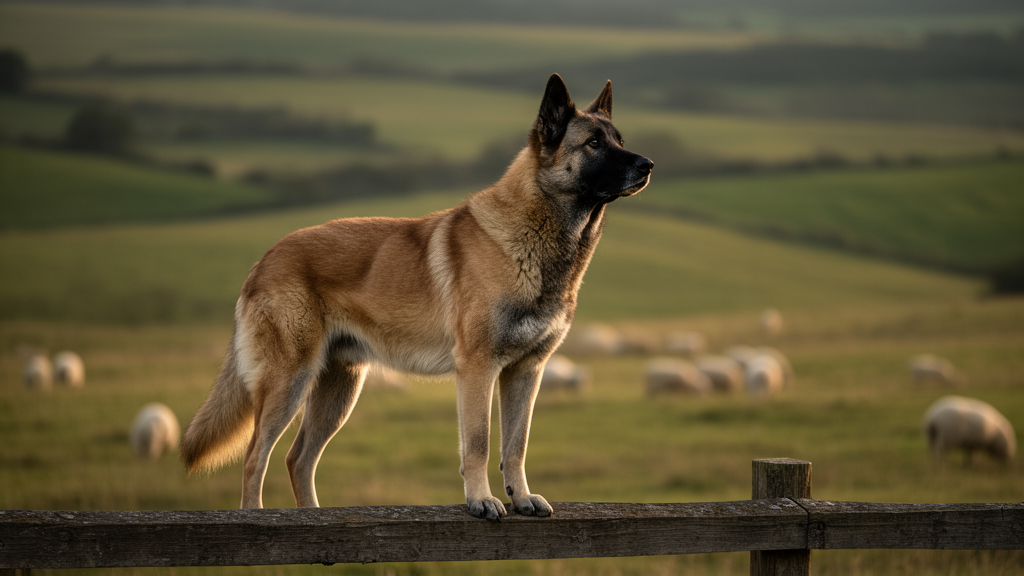
A dog bred to sleep in a pen with lambs for protection against wolves will not come when called if it decides the yard is worth guarding. The Anatolian Shepherd, also known as the Kangal in its native Turkey, is not a breed that values obedience for its own sake. It values the job. When you see an Anatolian Shepherd sit on a fence and stare at a passing squirrel without moving, you are not looking at a dog that is ignoring you. You are looking at a working animal that has evaluated the threat level, determined the threat is irrelevant to its charge, and made a conscious decision to prioritize the herd over your command.
This is the core misunderstanding that leads to the label of “stubbornness.” People expect a dog to be a subordinate partner, waiting for instructions. The Anatolian Shepherd is a guardian. It is a decision-maker. And when you try to train a decision-maker using the same methods you use for a subordinate, you will get resistance. This is not a personality flaw. It is the exact trait that kept these dogs alive in the harsh, predator-filled highlands of Turkey for thousands of years.
Guardian vs. Herder: The Critical Distinction
To understand why the Anatolian Shepherd behaves the way it does, you have to understand what it was bred to do. Most popular herding breeds, like the Border Collie or the Australian Shepherd, were bred to work closely with a human handler. They are “eye” dogs. They stare at the sheep, use body language to move them, and rely on the handler’s voice for direction. If the handler is not present, the Border Collie is lost. It has no independent strategy for managing livestock.
The Anatolian Shepherd is a livestock guardian dog (LGD). It was bred to live with the sheep, not to move them. Its job was to sleep in the pen with the lambs, to patrol the perimeter, and to kill any predator that got too close. Wolves, bears, and jackals do not care about your command structure. They do not care if you are watching. The Anatolian Shepherd had to be autonomous. It had to make life-or-death decisions about when to engage, when to retreat, and when to ignore a threat entirely to conserve energy for the real danger.
This autonomy is the root of its independence. A Border Collie that ignores you is a broken tool. An Anatolian Shepherd that ignores you is doing its job. It is assessing the environment. It is deciding that your command to “come” is less important than the security of the flock it has bonded with. This is not stubbornness. It is professional focus.
Why Standard Training Fails
Most dog training is built on the premise that the dog wants to please you. This works beautifully for breeds that were selected for cooperation and proximity to humans. It fails catastrophically with breeds that were selected for independence and distance. When you use positive reinforcement or negative punishment on an Anatolian Shepherd, you are speaking a language it does not natively understand.
Consider a simple recall. You call your dog. It does not come. You call again, louder. It looks at you, then looks back at the yard. In a Border Collie, this might be a momentary distraction. In an Anatolian Shepherd, this is a risk assessment. It is calculating whether leaving the safety of the flock to come to you is worth the potential exposure to a predator. If it decides the yard is safe, it will stay. If you punish it for staying, you are not teaching it to come. You are teaching it that you are a source of discomfort, and that the yard is the only place it can make its own decisions without interference.
This dynamic creates a dog that is incredibly difficult to housebreak, difficult to leash-walk, and difficult to recall. It is not because the dog is “bad.” It is because the dog is operating on a different value system. It values the safety of its charge over the approval of its human. This is a feature, not a bug. It is the reason these dogs have been trusted with livestock for millennia.
How to Work With, Not Against, the Instinct
If you own an Anatolian Shepherd, or are considering one, you must abandon the goal of perfect obedience. You cannot train a guardian to be a subordinate. You can only train it to be a reliable partner. This requires a shift in mindset from “command and control” to “negotiation and trust.” Here is how to do it.
First, focus on bond, not obedience. Your dog must trust you implicitly. This means you are the source of good things: food, play, comfort, and safety. You are not the source of correction. You are the source of value. When your dog chooses to come to you, it is because it wants to, not because it fears punishment. This builds a foundation of trust that is essential for any LGD.
Second, manage the environment. Do not expect your Anatolian Shepherd to come when called in an open field if it has not been trained to do so. This is dangerous. Use a long line or a fenced yard. Let it do its job within safe boundaries. If you cannot provide a secure environment, you cannot own this breed. This is not a suggestion. It is a requirement for the dog’s safety and the safety of others.
Third, use engagement-based training. Instead of demanding compliance, make yourself more interesting than the environment. If your dog is staring at a squirrel, do not yell. Do not pull the leash. Instead, use a high-value treat to break its focus. Reward it for looking at you. Then reward it for coming to you. This teaches your dog that paying attention to you is more rewarding than ignoring you. It does not force it to come. It invites it to come.
Finally, respect its autonomy. If your dog decides to sit on the fence and ignore you, let it. Do not punish it. Do not yell at it. Acknowledge that it is doing its job. Then, when it is ready, call it in a calm, inviting voice. If it comes, reward it heavily. If it does not, do not punish it. Simply end the interaction. This teaches your dog that coming to you is a choice that leads to good things, while staying on the fence leads to nothing. This is the only way to build a reliable partnership with an independent breed.
The Bigger Picture: Why This Matters
The Anatolian Shepherd is not a pet. It is a working animal. It is a guardian. When we label its independence as “stubbornness,” we are not just mislabeling a behavior. We are misinterpreting its nature. We are judging a fish by its ability to climb a tree.
If you want a dog that will obey you without question, get a Border Collie. If you want a dog that will think for itself, protect your home, and make its own decisions, get an Anatolian Shepherd. But do not expect it to be the same dog. It will not be. It will be something more complex, more challenging, and more rewarding. It will be a partner, not a subordinate. And if you respect that, you will have a dog that is not just loyal, but truly indispensable.
Sources & Further Reading
- Livestock Guardian Dogs: A Review of Their History, Behavior, and Management — ResearchGate
- Anatolian Shepherd Dog — Wikipedia
- Working Dogs: Their Skills, Talents, and Roles — Association of Professional Dog Trainers
- The Anatolian Shepherd: A Breed Profile — American Kennel Club