The 1935 Experiment That Proved Most Dog Food Wasn’t Food
In 1935, a team of USDA biochemists ran a feeding trial on forty dogs that would have been considered cruel by modern standards, but was simply the baseline for nutritional science at the time. They fed each dog a different commercial dog food available in American grocery stores. The ingredients varied wildly: ground beef, wheat middlings, bone meal, dried milk, and sometimes nothing but dried chicken scraps. The dogs were weighed weekly. Their coats were inspected. Their urine was tested.
After six months, three dogs had developed rickets. Two had severe dermatitis. One was so anemic he could barely stand. The others were alive, but barely. The foods labeled as “complete” and “balanced” on the packaging were, by modern veterinary standards, nutritional suicide. The dogs weren’t dying because the food was toxic. They were dying because it was incomplete.
This is not a history lesson. It is a warning label. When you look at your dog’s kibble bag today, you are looking at a product that has solved the problem of survival, but not the problem of thriving. The average dog owner does not feed their dog poison. They feed them a slow-acting deficiency. And the reason they don’t notice is that dogs are remarkably good at masking illness until it is advanced.
Your dog’s diet isn’t balanced. It’s just not poisonous yet.
The Myth of the “Complete and Balanced” Label
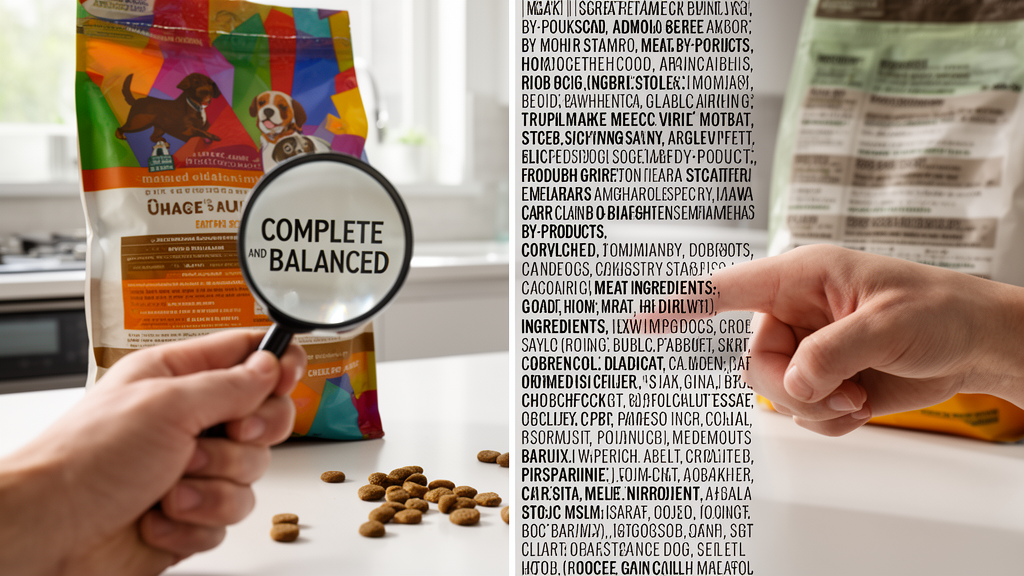
Every bag of dog food in the United States that meets minimum nutritional requirements is legally allowed to carry the phrase “complete and balanced.” This phrase is the single most powerful marketing tool in the pet industry, and it is also the single most misunderstood by the people buying the product. It does not mean the food is optimal. It does not mean the food is high quality. It means the food will keep your dog alive long enough to buy another bag.
The legal definition comes from the Association of American Feed Control Officials (AAFCO). To use the phrase, a manufacturer must either prove their formula meets the nutrient profiles established by AAFCO scientists, or feed the food to a small group of dogs for ninety days and show that the dogs survived without developing obvious nutritional deficiencies. This is the 1935 experiment updated for the modern era. It is a test of survival, not health.
Survival is a low bar. A dog can survive on a diet that is deficient in essential fatty acids, low in bioavailable protein, and high in fillers that provide empty calories. The dog will not develop rickets in ninety days. The dog will not go anemic in ninety days. The dog will simply age faster, develop a dull coat, and carry extra weight. These are not immediate emergencies. They are slow-acting deficiencies that accumulate over years.
When you read “complete and balanced,” you are reading a legal disclaimer, not a quality guarantee. It tells you the food meets the minimum standard for survival. It does not tell you how well your dog will live.
How to Read the Ingredient List
The ingredient list on a dog food bag is not a menu. It is a legal disclosure. The ingredients are listed by weight, from heaviest to lightest, before cooking. This matters because cooking changes the weight of ingredients. Vegetables lose water and shrink. Meat loses water and shrinks. But the list is generated before that happens.
Consider a food that lists “chicken” as the first ingredient, followed by “chicken meal,” followed by “corn,” followed by “wheat middlings.” Before cooking, the fresh chicken weighs more than the dried corn. After cooking, the fresh chicken loses so much water that it weighs less than the corn. The ingredient list is therefore misleading. The corn is actually the primary ingredient by weight after processing.
This is not a trick. It is physics. The ingredient list is designed to make the product look better than it is. It is not designed to tell you what your dog is actually eating.
To read the ingredient list correctly, you must understand what each term means. “Chicken” is fresh meat, which is mostly water. “Chicken meal” is cooked, dried, and ground meat, which is concentrated protein. “Chicken by-product meal” is ground up organs, feet, and beaks, which are nutritious but less desirable than muscle meat. “Meat by-products” is undefined and can include anything from the slaughterhouse that is not muscle meat.
When you see “meat by-products” on a label, you are looking at a waste product.It is simply low quality. It is the difference between eating a steak and eating the scraps left over after the steak has been cut.
The Protein Trap
Protein is the most important nutrient in a dog’s diet. Dogs are facultative carnivores. They evolved to eat meat, and their bodies are designed to process protein and fat. Carbohydrates are optional. Protein is essential.
Most dog food labels list protein as a percentage. This sounds precise. It is not. The percentage is calculated using a method called the Kjeldahl test, which measures total nitrogen in the food. Nitrogen comes from protein, but it also comes from non-protein sources like urea, ammonia, and synthetic amino acids.
Manufacturers can artificially inflate the protein number on the label by adding cheap nitrogen sources. This is called protein spiking. The food will test high on the label, but the dog will not get the protein it needs. The dog will simply excrete the excess nitrogen.
This is why the protein percentage on the label is meaningless. It tells you nothing about the quality of the protein. It tells you nothing about how much of the protein is bioavailable. It tells you nothing about the amino acid profile.
To understand the protein in a dog food, you must look at the source. A food that lists “chicken” as the first ingredient is providing a different protein profile than a food that lists “corn gluten meal” as the first ingredient. The chicken provides essential amino acids. The corn gluten meal provides incomplete protein that must be supplemented.
This is not a minor detail. It is the difference between a dog that thrives and a dog that survives. It is the difference between a dog that lives to fifteen and a dog that dies at eight.
The Hidden Cost of Fillers
Fillers are the hidden cost of cheap dog food. They are carbohydrates that provide calories but no nutritional value. They are used to bulk up the food and reduce the cost of production. They are not toxic. They are not illegal. They are simply empty calories that displace more nutritious ingredients.
Common fillers include corn, wheat, soy, and rice. These ingredients are cheap, widely available, and easy to process. They are also difficult for dogs to digest. Dogs lack the enzymes to break down complex carbohydrates efficiently. When a dog eats a food that is high in fillers, it must work harder to extract the nutrients it needs.
This is why dogs that eat high-filler foods often have large, frequent stools. The food passes through the digestive system without being fully absorbed. The dog is eating, but it is not getting the nutrition it needs. This is a slow-acting deficiency that accumulates over time.
Fillers are also linked to obesity and diabetes. When a dog eats a food that is high in carbohydrates, its blood sugar spikes. The pancreas releases insulin to manage the spike. Over time, the dog becomes insulin resistant. This is the path to diabetes.
It is a major health risk. It is the difference between a dog that lives a long, healthy life and a dog that suffers from chronic disease.
How to Choose a Better Food
Choosing a better food does not require a degree in nutrition. It requires a willingness to read the label and ask the right questions. The first question is: what is the primary ingredient? If the primary ingredient is a filler, the food is low quality. If the primary ingredient is a named meat source, the food is higher quality.
The second question is: what is the protein source? If the protein source is a by-product or a filler, the food is lower quality.
The third question is: what is the fat source? Fat is essential for a dog’s health. It provides energy, supports skin and coat health, and helps absorb vitamins. A food that lists a named fat source, such as “chicken fat” or “salmon oil,” is higher quality than a food that lists “animal fat” or “vegetable oil.” Animal fat is undefined and can come from any source. Vegetable oil is not a natural source of fat for dogs.
Fiber is necessary for digestive health. A food that lists a named fiber source, such as “beet pulp” or “pumpkin,” is higher quality than a food that lists “corn husks” or “wood pulp.” Corn husks are a filler. Beet pulp is a prebiotic that supports gut health.
These questions are not exhaustive. They are a starting point. They will help you distinguish between a food that is designed to keep your dog alive and a food that is designed to help your dog thrive.
The Real Meaning of “Balanced”
When you read “balanced” on a dog food label, you are reading a legal term, not a quality guarantee.
Your dog’s diet is not balanced. It is just not poisonous yet. The food will keep your dog alive. It will not help your dog thrive. It will not prevent disease. It will not extend your dog’s life.
This is not a criticism of the dog food industry. It is a criticism of the consumer. You are buying a product that is designed to keep your dog alive. You are paying for survival, not health.
It is time to stop reading the label and start reading the food. It is time to stop buying survival and start buying health. It is time to stop feeding your dog poison and start feeding your dog food.
But it will be. And when it is, it will be too late to change the label.