Everyone agrees that eye contact is the foundation of good training. It is the golden signal, the bridge between you and your dog, the thing that turns a distracted puppy into a focused partner. So you ask for it. You wait for the look. You click. You treat. And your dog, who was perfectly content sniffing a blade of grass or watching a leaf fall, now stares at you with a dead-eyed intensity, waiting for the next command, unable to relax, unable to just be a dog.
The eye contact trap is not about focus. It is about cognitive overload, and it is slowly eroding your dog’s ability to make choices on his own.
The problem is not that dogs should make eye contact. The problem is that you have turned a voluntary social signal into a mandatory tax on every single interaction. When you demand eye contact before every treat, you are not teaching your dog to focus. You are teaching him that his attention is a commodity you extract, and that the only way to get the good stuff is to shut down his own curiosity and fixate on your face. This is a classic case of misread-signal: you see a dog looking at you and assume he is engaged, but ethologically, you are looking at a dog who is suppressing his natural environmental scanning to appease you.
The Biology of the Forced Stare
To understand why this backfires, you have to look at what eye contact actually means in canine social dynamics. In the wild, and in the social lives of wolves and free-roaming dogs, prolonged, unbroken eye contact is not a friendly greeting. It is a threat. It is a challenge. It is the prelude to a fight. Dogs communicate interest through soft, fleeting glances, often accompanied by averted heads, lip licks, or turning their bodies slightly away. When you force a dog to hold your gaze, you are asking him to perform a behavior that is biologically stressful, even if he is not showing obvious signs of aggression.
Research into canine cognition, particularly the work of researchers like Alexandra Horowitz and Ádám Miklósi, highlights that dogs are highly attuned to human social cues, but they process them differently than we do. When a dog voluntarily looks at a human, it is often to check in for information or to share an experience. This is a low-stakes, high-trust interaction. But when that glance is extracted as a prerequisite for a reward, the dynamic shifts. The dog is no longer sharing; he is performing. And performance, when it is mandatory, triggers a low-level stress response.
Consider the physiological changes in a dog forced to maintain eye contact. His heart rate may not spike dramatically, but his cortisol levels can rise, especially if he is unsure of the exact timing or duration required. He is holding his breath, stiffening his neck, and narrowing his visual field. He is no longer taking in the periphery. He is no longer aware of the other dogs, the cars, the people, or the environment. He is locked in a tunnel vision that makes him vulnerable. This is not focus. This is fixation. And fixation is the enemy of a well-adjusted dog.
The Cognitive Load of Constant Monitoring
Every time you ask for eye contact, you are adding cognitive load to your dog’s brain. He is not just processing the environment; he is processing you. He is calculating: “Do I look at her face? How long? What happens if I look away?” This constant monitoring is exhausting. It is the mental equivalent of holding your arm out straight while someone adds weights to your hand. Eventually, your arm drops. Eventually, your dog disengages. And when he disengages, you often label it as “distraction” or “defiance,” rather than recognizing it as the natural limit of his cognitive capacity.
This is where the “no free lunch” rule comes into play. In training, a “free lunch” is an interaction that provides value to the dog without requiring him to perform a specific behavior. A sniff is a free lunch. A look at a bird is a free lunch. A moment of rest is a free lunch. When you demand eye contact before every treat, you are removing all free lunches. You are turning every moment into a transaction. And when every moment is a transaction, the dog stops enjoying the world. He starts scanning for your face, looking for the cue, waiting for the command. He becomes a machine, not a partner.
Think about your own life. If you had to look your boss in the eye every time you wanted a snack, or every time you wanted to use the restroom, or every time you wanted to ask a question, how would you feel? You would feel watched. You would feel controlled. You would feel anxious. Now imagine that feeling is your dog’s baseline. That is the eye contact trap. It is a behavioral cage.
What Real Engagement Looks Like
Real engagement is not a stare. It is a dynamic, fluid exchange of information. It is the dog looking at you, then looking at the world, then looking back at you to share a reaction. It is the “check-in” that happens naturally when a dog is comfortable and confident. This kind of engagement is voluntary. It is offered. And it is the only kind of engagement that leads to true, lasting focus.
Consider the difference between a dog who is trained to stare and a dog who is trained to engage. The staring dog will freeze when he sees a squirrel. He will lock onto your face, waiting for you to tell him what to do. He will not look at the squirrel. He will not process the threat. He will simply wait. The engaging dog, however, will look at the squirrel, look at you, look back at the squirrel, and then decide. He is processing the environment. He is using his own judgment. He is not a puppet. He is a partner.
This is the core of modern, science-based training. It is about communication. It is about building a relationship where the dog feels safe enough to explore, confident enough to make choices, and trusted enough to check in with you when he needs to. This is not achieved by demanding eye contact. It is achieved by rewarding voluntary glances, by allowing free lunches, and by understanding that a dog’s attention is not a resource to be mined, but a gift to be received.
How to Break the Trap
Breaking the eye contact trap is not about stopping eye contact altogether. It is about changing the ratio. It is about making eye contact one tool in your toolbox, not the entire toolbox. Here is how to do it.
First, stop asking for eye contact before every treat. Let your dog eat his treats while looking at the ground. Let him sniff the air. Let him look at the world. You are not losing his focus. You are giving him back his freedom. This will feel strange at first. You might feel like you are losing control. But trust me, you are not. You are building a stronger, more resilient dog.
Second, reward voluntary eye contact. When your dog looks at you on his own, when he checks in without being asked, mark that behavior. Reward it. But do not demand it. Let it be his choice. This reinforces the idea that looking at you is a good thing, but it is an option. And options build confidence.
Third, use eye contact as a high-value cue, not a low-value tax. Reserve the “look” command for high-distraction environments or high-stakes situations. When you are walking past a busy street, or when there are other dogs nearby, ask for eye contact. Reward it generously. But when you are at home, or in a quiet park, let your dog be a dog. Let him sniff. Let him explore. Let him rest. This contextual use of eye contact makes it powerful. It is a spotlight.
Finally, understand that your dog’s attention is not a finite resource. It is a renewable one. When you allow him to disengage, to look away, to process the environment, he recharges. He resets. And when he looks back at you, it is fresh. It is genuine. It is real. This is the kind of focus that lasts. This is the kind of focus that saves your dog’s life.
The Bigger Picture: Trust Over Control
The eye contact trap is a symptom of a larger cultural issue in dog training. We are obsessed with control. We want dogs who look at us all the time. We want dogs who never look away. We want dogs who are always focused on us. But dogs are not humans. They are not designed to stare. They are designed to scan. They are designed to be aware. They are designed to be free.
When we force them to stare, we are not making them better dogs. We are making them worse dogs. We are stripping them of their natural instincts. We are suppressing their curiosity. We are breaking their spirit. And we are doing it in the name of “training.” This is not training. This is domination. And it is time we stopped.
Real training is about trust. It is about understanding that a dog’s attention is not a resource to be mined, but a gift to be received. It is about respecting the dog as a living, breathing, thinking being, not a machine to be programmed.
If you want a dog who looks at you, let him look at you. If you want a dog who focuses, let him focus. Do not extract it. Do not tax it. Let it be his gift. And when he gives it to you, cherish it. Because it is trust. And trust is the only thing that truly matters.
Sources & Further Reading
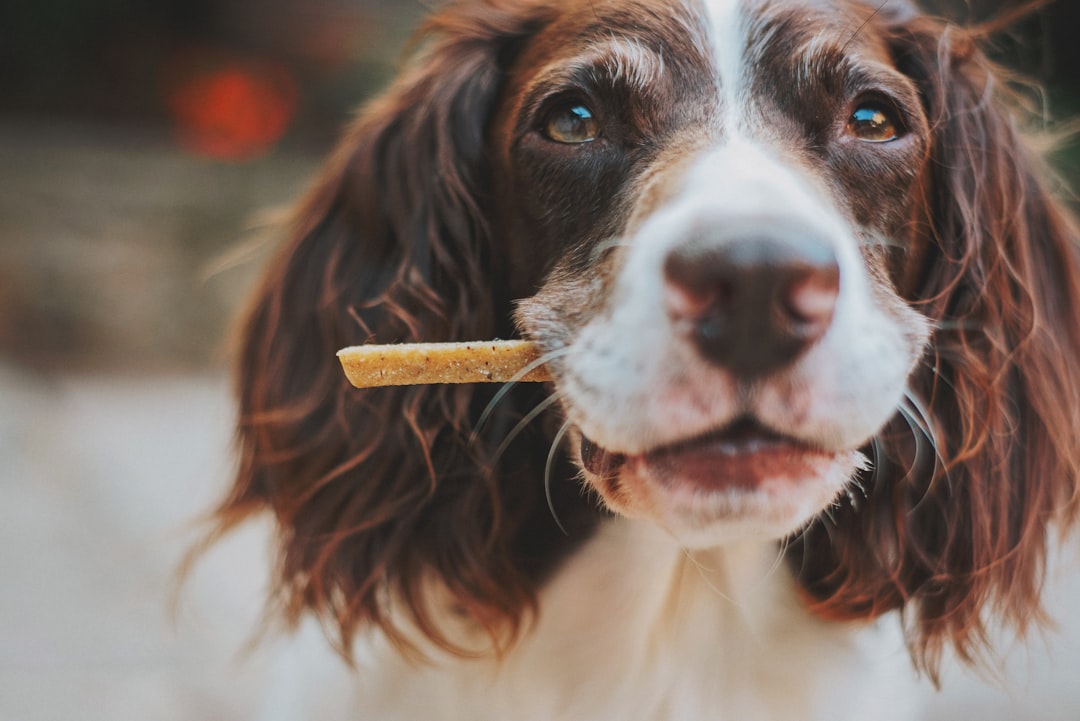
Photo by James Lacy on Unsplash.